
January 9 & 11(m), 2026
Meyerson Symphony Center
Dallas, TX – USA
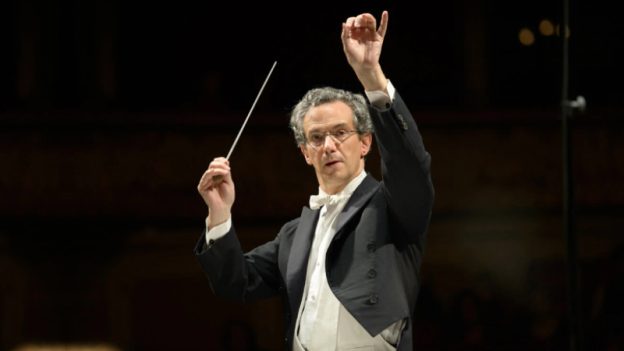
Dallas Symphony Orchestra & Chorus, Fabio Luisi, conductor, Jennifer Rowley (Cio-Cio-San), Manuela Custer (Suzuki), Evan LeRoy Johnson (Pinkerton), Alessandro Luongo (Sharpless), Keith Jameson (Goro).
Giacomo PUCCINI: Madama Butterfly
Gregory Sullivan Isaacs | 15 JAN 2026
The Dallas Symphony Orchestra presented Puccini’s opera, Madama Butterfly, on the stage in Dallas’ Meyerson Symphony Centre last Friday night, January 9. It is hard to understand why symphony orchestras occasionally try to present operas in acoustically excellent, but otherwise woefully inadequate venues (beyond the music director’s desire to conduct them). However, primarily due to the everlasting popularity of Puccini’s tuneful three-hanky opera, the DSO sold out the house. But the problems with this production proliferated.
Staging: The action took place on the skimpy apron of the stage, which was otherwise filled with the orchestra. Separation from the players, which could have been provided by a 3’ curtain, was not provided.
The cast: The title role of Cio-Cio-San was effectively sung by soprano Jennifer Rowley. This is one of a list of “impossible roles to realistically cast,” considering that she is supposed to be 15 years old at the time of her “marriage” to the clueless American naval officer. (He considers her to be rented for the time he is stationed in Japan.) Her costume was an unwieldy and boldly printed dress with an overcoat. Other than dealing with that, she completely inhabited the role, both vocally and dramatically.
The critical role of Suziki, Butterfly’s chambermaid (really a personal servant and confidant), was excellently portrayed by mezzo-soprano Manuela Custer. Vocally, she sang with sensitivity and emotion, though her chest voice was noticeably darker and considerably louder on the few occasions she used it.
Tenor Evan LeRoy Johnson as Pinkerton had a forceful voice, more Germanic than Italian, with a surprising blast he lavished on the very highest notes. Acting-wise, he was perfect as the clueless American cad, banging his way through Japanese culture without a single thought about the trail of cultural debris left in his wake. Baritone Alessandro Luongo portrayed Sharpless, the American consul. He displayed a beautiful voice — a creamy lyric baritone. Dramatically, he was at his best in the final scenes, forcefully reminding the oblivious Pinkerton of the damage he was doing to Butterfly even before the wedding. Keith Jameson was typically slimy as Goro, Butterfly’s marriage broker. The chorus was seated in the choral terrace behind the orchestra in concert dress.
On the podium, Luisi’s heavy-handed reading pushed the volume way up throughout the performance. He also brought some questionable interpretative values. For example, the charming fugue that opens the opera was designed to create a sense of busyness around the wedding preparations. Instead, in Luisi’s loud and rushed reading, it felt more like panic. Also, he clobbered the surprising final chord with a huge gesture. Rather than ending in the expected key of C minor, Puccini uses an unusual first inversion of G major, the dominant. As a result, the opera ends with a feeling of something ominous, foreboding, and unfinished.
Why does this opera require a different approach?
Giacomo Puccini’s opera, with an Italian libretto by Luigi Illica and Giuseppe Giacosa, had deep roots. Butterfly’s tragic example of victimisation by American imperialism and its devastating impact on naive culture first appeared in a 1898 short story titled Madame Butterfly by John Luther Long. (Also, in 1887, there was a similar French novel titled Madame Chrysanthème by Pierre Loti.)
Long’s version found its way to the stage via a one-act play by David Belasco titled Madame Butterfly: A Tragedy of Japan. After premiering in New York in 1900, Belasco’s version moved to London, where a fascinated Puccini saw it in the summer of that year.
Starting in the 1880’s, Japan was certainly a subject of fascination in the West. Everything about the newly discovered country was diametrically opposite to the rest of the world. The teenage emperor, Mutsuhito, claimed power on January 3, 1868 (called the “Meiji Restoration”). He opened the country to the barbaric West. The Treaty of Kanagawa (1854) established universal trade and diplomatic relations with the world. At that point, the word was out, or as the Japanese might say, himitsu ga moreta. (秘密が漏れた or “the secret leaked.”)
And leek it did! The 1880’s saw a profusion of interest in Japanese art and culture. Their minimalist character, simplicity of expression, and purity of beauty were completely different from Western chromatic realism and layered Impressionism. It inspired a revolution towards a subjective vision and beauty created by simplicity, setting the stage for Modernism and beyond.
It was a moment when the world changed.
Musical and dramatic artists also welcomed this refreshing reversal but had a more difficult time shedding the über-romanticism of the era, in which Wagner ruled as a tyrant. (1877 saw the premiere of Parsifal).
Despite criticism of the opera for racism and oriental insensitivity, it is still much better about it than it is in Belasco’s play. In that, Butterfly speaks in a dialect satire, such as when preparing for Pinkerton’s return: “Bring me my wides’ obi, kanzashi for my hair, poppies-mus’ look ver’ pretty!” ■
EXTERNAL LINKS:
- Dallas Symphony Orchestra: dallassymphony.org
- Fabio Luisi: fabioluisi.com
- Jennifer Rowley: jenniferrowley.com
- Manuela Custer: operabase.com/manuela-custer-a10951
- Evan LeRoy Johnson: opus3artists.com/artists/evan-leroy-johnson
- Alessandro Luongo: wiener-staatsoper.at/en/ensemble/detail/alessandro-luongo
- Keith Jameson: metopera.org/discover/artists/tenor/keith-jameson

Read more by Gregory Sullivan Isaacs.




.png)