

Orchestra offers a touching tribute to longtime Houston Symphony violinist Marina Brubaker
March 14, 2026
Jones Hall Houston, Texas – USA
Houston Symphony, Vasily Petrenko, conductor; Jan Lisiecki, piano. Sopranos and Altos of the Houston Symphony Chorus; Anthony J. Maglione, director.
Alfred NEWMAN / Max STEINER: Suite from Wuthering Heights (1939)
Wolfgang Amadeus MOZART: Piano Concerto No. 9 in E-flat major, K. 271, “Jeunehomme” (1777)
Edward ELGAR: Variations on an Original Theme “Enigma,” Op. 36 (1899)
Lawrence Wheeler | 15 MAR 2026
Saturday’s Houston Symphony concert at Jones Hall carried an added sense of reflection, dedicated to longtime violinist Marina Brubaker. Guest conductor Vasily Petrenko, returning after a thirteen-year absence, led a program ranging from Alfred Newman’s Hollywood romanticism to Elgar’s deeply personal Enigma Variations. Pianist Jan Lisiecki joined him for Mozart’s Piano Concerto No. 9 in E-flat major. The sopranos and altos of the Houston Symphony Chorus also appeared in an arrangement of Newman’s music from the film Wuthering Heights. That story of ill-fated lovers united in death made the program an unofficial extension of the Symphony’s Doomed Lovers Festival.
Before the music began, Houston Symphony Executive Director and CEO Gary Ginstling came onstage to dedicate the evening to Marina Brubaker, a 38-year member of the first violin section who recently died after a heroic battle with cancer. In her memory, concertmaster Yoonshin Song led the string section in the “Sarabande” from Edvard Grieg’s Holberg Suite, a touching tribute highlighted by a beautifully played cello trio.
The 1939 film Wuthering Heights is based on Emily Brontë’s 1847 novel of the same name. Its score was composed by Alfred Newman, widely regarded as the most influential music director of Hollywood’s Golden Age. In that same year, Newman also wrote the scores for The Hunchback of Notre Dame, The Rains Came , and They Shall Have Music, the latter featuring the great violinist Jascha Heifetz. At the Academy Awards, Wuthering Heights and The Rains Came were nominated for Best Original Score alongside Gone With the Wind and The Wizard of Oz, among others—a remarkable year for film music.
The score for Wuthering Heights exemplifies the illustrative techniques that dominated Hollywood scoring in the 1930s, with leitmotifs representing characters, places, and emotions. Unapologetically dramatic and romantic, the music echoes Richard Strauss and Ottorino Respighi while also suggesting the atmosphere of a Broadway musical—unsurprising, given that Newman spent the first decade of his career conducting in musical theater.
The selection heard here was a 13-minute suite arranged by composer and orchestrator Fred Steiner, consisting of nine sections loosely following the film’s storyline. Both Newman and Steiner were master orchestrators. Details such as low-register flutes, harp, piano, and celeste added tonal variety. The violin section carried the score’s soaring melodies, while solo woodwinds supplied character and color.
Petrenko led a colorful and expressive account of the suite. His fluid, circular conducting style did not always suggest tight ensemble, but concertmaster Yoonshin Song’s leadership ensured cohesion. Song also led a solo string quartet passage in which balance might have benefited from a more outward seating position for projection. The wordless women’s chorus sang admirably in the final minutes. Though the passage was originally scored for children’s chorus, the fuller adult sound lent added weight to the suite’s stirring conclusion.
Jan Lisiecki made his Houston Symphony debut four years ago in Beethoven’s Piano Concerto No. 4, conducted by former music director Christoph Eschenbach. At that time, his stage demeanor struck me as formally reserved, his playing technically impeccable but with a somewhat digital quality. Now approaching 31, Lisiecki remains a frequent guest with many of the world’s leading orchestras, and Mozart’s concertos occupy a prominent place in his repertoire.
In the Piano Concerto No. 9, his playing revealed a mature artist increasingly focused on expressive nuance. With his shoulders relaxed and his head turned outward, Lisiecki maintained an impeccable ensemble throughout. His cadenzas were flexible and imaginative, while the C-minor second movement unfolded with intimate expression and beautifully controlled pianissimos. The exuberant Rondo finale dispelled the movement’s introspection, delivered with superb rhythmic control and the crystalline clarity of a flawless diamond—remarkably, the only imperfection was a single stray note.
Petrenko’s conducting was unfussy yet sensitive to dynamics and phrasing. His fluid gestures rarely showed the clear ictus often associated with Classical-period repertoire, leaving much of the ensemble precision to the players themselves—something the experienced Houston Symphony handled with confidence. Dual oboes and horns balanced well with the reduced string forces.
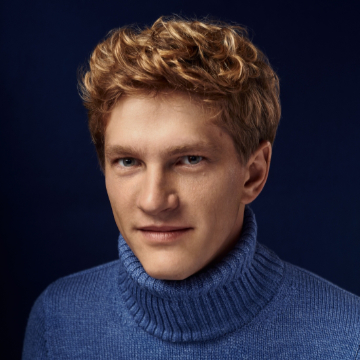
Jan Lisiecki (credit: Ksawery Zamoyski)
An enthusiastic audience response brought an encore: Chopin’s Grand valse brillante, Op. 18, also in E-flat major. Lisiecki played with consummate elegance and polish, again using the sustaining pedal sparingly. Next week, he will perform the same Mozart concerto with the San Francisco Symphony under former Houston Symphony music director Andrés Orozco-Estrada.
Edward Elgar’s Enigma Variations remains a cornerstone of the orchestral repertoire. The work consists of a theme followed by fourteen variations portraying the composer’s wife, friends, and even a friend’s dog. Elgar famously never revealed the identity of the underlying “enigma” theme, prompting endless speculation. Since the variations were intended as affectionate portraits of his inner circle, I am inclined to imagine a more private reference—perhaps even “Happy Birthday,” for which intriguing musical parallels can be found.
Petrenko, music director of the Royal Philharmonic Orchestra since 2021 and previously chief conductor of the Royal Liverpool Philharmonic Orchestra for fifteen years, brought a touch of London tradition to the performance. The opening measures felt conversational rather than overtly melodic, with space between phrases. Petrenko moved quickly between variations, maintaining momentum while preserving clarity of texture even in the densest passages.
The Houston Symphony knows this score well, which helped accommodate Petrenko’s expression-centered approach. Even so, there was a moment of uncertainty at the start of the spiccato second variation. Several orchestral solos stood out. Violist Joan DerHovsepian played beautifully shaped solos in Variations VI and X, while cellist Brinton Smith was equally eloquent in Variation XII. In Variation VII, timpanist Leonardo Soto offered a preview of his soloistic flair ahead of next week’s concerto appearance. Flutist Matthew Roitstein and clarinetist Ben Freimuth also contributed notable solos, and the brass section was unified and powerful in climactic passages.
The emotional summit was the famous “Nimrod,” Variation IX. Perhaps influenced by the concert’s dedication, Petrenko shaped the music with exceptional tenderness and intensity. Though frequently heard at memorial services, the variation is not inherently mournful. In the right hands—as it was here—it becomes something larger: not an expression of grief, but a noble and deeply moving affirmation of life.
The program was repeated on Sunday afternoon. ■
EXTERNAL LINKS:
- Houston Symphony: houstonsymphony.org
- Vasily Petrenko: vasilypetrenkomusic.com
- Jan Lisiecki: janlisiecki.com/

Read more by Lawrence Wheeler.


.png)