
March 11, 2026
Fabian Concert Series
Spivey Hall
Morrow, Georgia – USA
James Ehnes, violin; Amy Schwartz Moretti, violin; Che-Yen Chen, viola; Edward Arron, cello; Orion Weiss, piano; Benjamin Linton, violin; Holly Parker, violin; Hanami Froom, violin; Sharon Montes, double bass.
Ludwig van BEETHOVEN: String Quartet in G major, Op. 18, No. 2
Astor PIAZZOLLA: Oblivion
Astor PIAZZOLLA: Libertango
Johannes BRAHMS: Piano Quintet in F minor, Op. 34
William Ford | 13 MAR 2026
Spivey Hall hosted an important first as the Fabian Concert Series made its debut at the venue. The series has been associated primarily with the Mercer University Townsend School of Music in Macon, home of the Robert McDuffie Center for Strings. Its appearance in Morrow brought the series’ distinctive blend of performance and mentorship to a broader Atlanta-area audience. Some 50 to 60 patrons were able to enjoy a world-class chamber ensemble originating from their own area.
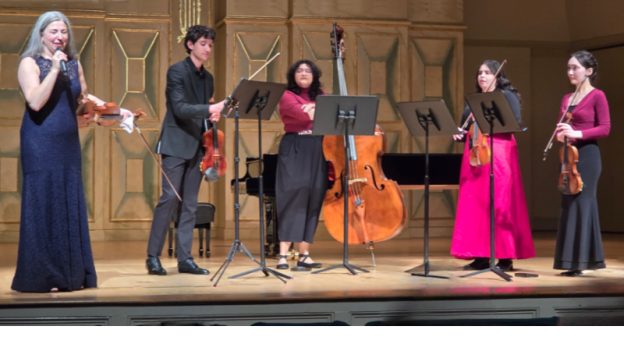
Curated by Amy Schwartz Moretti, Artistic Director of the McDuffie Center, the evening reflected the program’s emphasis on collaboration across generations. The internationally recognized Ehnes Quartet performed alongside pianist Orion Weiss, joined by select McDuffie Young Artists.
The Ehnes Quartet consists of James Ehnes (violin), Amy Schwartz Moretti (violin), Che-Yen Chen (viola), and Edward Arron (cello). Each member maintains an active international career as a soloist and chamber musician, and the ensemble frequently collaborates in performances connected with the McDuffie Center’s educational mission.
Dance forms provided the connective thread of the evening’s program. In Beethoven’s quartet, the rhythms of earlier court dances appear in refined and stylized form, while Piazzolla draws directly on the unmistakable pulse of the tango. Brahms, in turn, absorbs dance energy into the sweeping architecture of Romantic chamber music, where rhythmic drive becomes part of a larger symphonic design.
Spivey Hall’s clear, intimate acoustic proved well suited to the evening’s repertoire. The hall’s ability to project inner lines and subtle dynamic shifts often allows chamber textures to emerge with unusual clarity.
Beethoven’s String Quartet in G major, Op. 18 No. 2, marks the composer’s early engagement with the genre established by Haydn and Mozart. While the G major quartet retains the elegance of the classical style, it also reveals Beethoven’s growing interest in rhythmic play and instrumental dialogue. Once the Ehnes Quartet began to play, one was easily reminded why Spivey Hall is so ideal for chamber music: its clear, intimate acoustic projects inner lines and subtle dynamic shifts, allowing chamber textures to emerge with unusual clarity.
The opening “Allegro” unfolds with quick exchanges among the instruments, creating a lively conversational texture. The “Adagio” cantabile introduces a lyrical contrast, interrupted by a brief faster section before returning to its opening character. The “Scherzo” replaces the traditional minuet with a more playful and rhythmically pointed movement, and the final “Allegro molto, quasi presto” brings the work to an energetic close.
The Ehnes Quartet performed with immaculate precision while maintaining the lyrical warmth the music requires, particularly in the second movement. In the finale, Beethoven offers an early glimpse of the restless energy that would later define his monumental string quartets, and here the ensemble’s precision brought that vitality fully into focus.
Astor Piazzolla transformed the Argentine tango into a concert genre often called tango nuevo, combining traditional dance rhythms with elements of jazz harmony and classical chamber writing. In these two pieces, Ms. Schwartz-Moretti was joined by four McDuffie students: Benjamin Linton (violin), Holly Parker (violin), Hanami Froom (violin), and Sharon Montes (double bass), expanding the ensemble for these tango-inflected works.
Oblivion unfolds as a slow, lyrical meditation built around a haunting melodic line. Its restrained atmosphere contrasts sharply with Libertango, whose driving rhythm and sharp accents create one of Piazzolla’s most recognizable works.
These cabaret-style pieces feature an intense melodic line underscored by unmistakable tango rhythms. The first violin carries most of the melodic weight, occasionally shared with the second violin. Ms. Schwartz-Moretti played with sweep and intensity, supported by a strong, confident bow technique, while the rhythmic foundation was largely provided by the student players. The music’s infectious character created a stylistic pivot in the program, something like a quick detour to the bar between two masters of the string quartet tradition. The audience showed its appreciation with prolonged applause.
Brahms’s Piano Quintet in F minor, Op. 34 stands among the most imposing works in the chamber repertoire. The composer struggled for years with the piece, first writing it as a string quintet and later recasting it for two pianos before arriving at the final piano quintet version.
The opening “Allegro non troppo” introduces a turbulent theme that sets the dramatic tone of the work. A more reflective atmosphere emerges in the “Andante, un poco adagio,” while the powerful “Scherzo” drives forward with relentless rhythmic energy. The “Finale” begins with a brief introduction before accelerating toward a tense and forceful conclusion.
I have heard this piece numerous times in recordings, but all pale beside the experience of hearing it in concert. The third movement is such a whirlwind of music that it is genuinely breathtaking. Here Brahms drives the music to a near frenzy, giving the Ehnes musicians an opportunity to display not only formidable technical command but also the ability to remain fully musical within the tornado of sound. The other movements demand something different—less explosive perhaps, but no less taxing in their musical and ensemble challenges. This big, thick, almost symphonic music was handled with such deftness that one could only admire both the ensemble’s stamina and its musical intelligence. The monumental work received a performance equal to its scale, making for a remarkable conclusion to the evening.
Taken as a whole, the evening reflected both thoughtful programming and exceptional musicianship. The members of the Ehnes Quartet combined technical brilliance with interpretive insight, shaping each work with precision, warmth, and stylistic awareness, while the McDuffie student musicians provided energetic and confident support.
The Fabian Concert Series returns to Spivey Hall on April 22 with Beethoven’s Piano Trio No. 7 in B-flat major, Op. 97, “Archduke,” whose expansive lyricism and architectural breadth balance intimacy with symphonic scope, followed by César Franck’s Piano Quintet in F minor, Op. 14, a work of dramatic sweep, lush harmony, and fervent thematic development. At a moment when opera and ballet have unexpectedly drifted into the pop-culture conversation, evenings like this provide a welcome reminder that the real story is still unfolding on the stage. On this night, the music made its own case. ■
EXTERNAL LINKS:
- James Ehnes (and Quartet): jamesehnes.com
- Orion Weiss: orionweiss.com
- KMcDuffie Center for Strings: mcduffie.mercer.edu
- Spivey Hall: spiveyhall.org

Read more by William Ford.


.png)