
Childhood curiosity and what education programs risk forgetting
Henry Cheng | 28 AUG 2026
• • •
When I was seven, summer seemed to last forever.
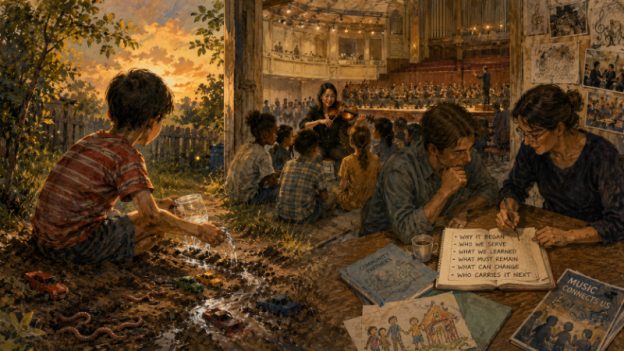
I had just moved to Georgia and was waiting to turn eight. In the backyard, I dug roads into the dirt for my Hot Wheels and borrowed the old plastic cup my mother used to water her little flowers. I tipped the water into the first turn. It widened one road, erased another, and sometimes carried a car somewhere I had not planned. When the wet ground brought worms to the surface, I stopped racing to watch their bodies squish together and release as they moved.
There were ants to follow, clouds moving through the branches, and fireflies that came out at night. Sweat ran down my face and soaked into my shirt, but I did not care. Tomorrow, I would make the roads longer, or deeper, or send them somewhere I had not thought of yet. There was always another day.
This summer passed in an instant. It was full of family, errands, responsibilities, and work that mattered. Life moved, and I moved with it, until I looked up and saw the children were already back in school, and summer had ended.
Those childhood days were full too, but nothing I built had to prove that it deserved another season. I poured the water to see where it would go. When it made a mess of the road, I began again. What remained was not the road. It was the curiosity that brought me back to it.
The road could disappear because curiosity did not. I knew I would return to it. An education program faces a harder problem: the people who begin the work are not always the ones who will carry it next.
Many orchestra education programs begin with a question: What if students could hear the orchestra from inside the music? What if a teaching artist returned often enough to learn the room? What if a concert were designed with a community rather than delivered to it? Musicians, teachers, and students try something, notice what happens, and adjust.
Then the students go home. The grant cycle closes. A staff member leaves. The next season begins.
The danger is not only that a program ends. It is that the program continues long after its curiosity has gone. The concert remains on the calendar, and the brochure keeps the same name, while the questions, relationships, and small discoveries that gave it life quietly disappear.
Continuity is what allows curiosity to survive the calendar. It does not keep a program exactly as it was. It carries forward the reason the work began, the relationships that changed it and the knowledge that lets someone else continue without starting from nothing.
The work lives in people
A new report from the League of American Orchestras, Orchestras Building Community Through Education and Engagement, shows how large this work has become. Drawing on a 2025 survey of 100 adult orchestras and 28 independent youth orchestras, the report estimates that U.S. adult orchestras engaged 4.6 million participants through 21,650 education, community-engagement and affiliated youth-orchestra concerts and events during the 2024–25 season.
Ninety percent of participants took part free of charge. 90% of activities took place in schools and other community settings rather than in an orchestra’s primary performance space. These are not small extensions of the concert hall. They are one of the places where orchestras meet the public most directly.
The most revealing figure may be less glamorous. Among the organizations that reported expenses, personnel accounted for 75 percent of the costs for education, community engagement, and affiliated youth orchestra. The report explains why: through sustained relationships with schools, participants and community organizations, staff members develop deep knowledge of local needs, barriers, resources and opportunities. One respondent called them the orchestra’s “boots on the ground.”
That knowledge rarely sits in one file. It lives in the person who knows why a school changed its arrival time, which teacher can settle a nervous room, why one invitation earned trust and another did not, or when the original plan should be set aside. If that person leaves, the dates and lesson plans may remain while part of the program vanishes.
A relationship, not a delivery system
Henry Fogel, former president and CEO of both the League of American Orchestras and the Chicago Symphony Orchestra, was writing from inside the field as orchestras began replacing the language of outreach with community engagement. His 2008 essay matters here because it names the change at the center of this story: from a program delivered outward to a relationship built together.
Fogel wrote that civic stature meant finding “relevance to people who may never come to a subscription concert,” and argued that the older word outreach could be one-directional and even condescending. Outreach imagined an orchestra deciding what a community needed and carrying it outward. Engagement began with a conversation.
A year earlier, writing about music education, Fogel drew an equally important boundary: “orchestra programs are not a substitute for professional music teachers in our school systems.” An orchestra could enrich sustained music education, but it could not replace the teachers and schools already carrying that responsibility.
Together, those ideas change the question from What can an orchestra deliver to What can people build together? They also change what must remain. If a community partner helped shape the work, continuity cannot be reduced to a folder passed between orchestra employees. It includes the partner’s memory, voice, and trust.
What a marked score cannot tell you
Orchestral musicians know the limits of a written mark. A pencil note in a part may show where the ensemble played less or took more time. It cannot remember the room, what a player noticed, why the balance changed, or how the hall answered. The mark preserves a decision, not the listening that produced it.
Educational work carries the same kind of knowledge. A contact list can preserve a partner’s name, but not the trust behind the call. A curriculum can preserve an activity, but not why a teacher changed the sequence. An attendance number can tell us how many people entered the room, but not why they wanted to return.
Documents matter. So do budgets, schedules, and grant reports. But the real work of continuity is to connect those records to human judgment before the judgment walks out the door.
Before the next season begins
Before a recurring program returns or changes hands, the people carrying it should be able to answer a few questions. Why did this begin? Whose trust makes it possible? What did we learn that is not in the program binder? What must remain, and what is free to change? Who else knows enough to carry it next?
The answers may fit on one page. The point is not the page. It is the conversation required to complete it, ideally with more than the current program lead and, where appropriate, someone from the school or community that shares the work. The questions reveal whether knowledge is held together or by a single person.
Continuity is not repetition
The League report is clear that strong programs adapt to community needs, participant feedback, partnerships, capacity, and staff expertise. Some are redesigned or expanded. Others end when they no longer meet local needs. That is not necessarily failure. A program can end, leaving honest learning behind. Another can remain on the calendar and become hollow.
Curiosity is what lets an organization notice the difference. It asks whether the people in the room have changed, whether the old design still serves them, and whether a partner is still being heard. Continuity gives that curiosity a memory. Without memory, every change begins from ignorance. Without curiosity, memory becomes a command to repeat the past.
Sustainability, then, is not the real point of this story. A thing can be sustained on autopilot. The larger question is whether an organization can carry forward enough purpose, trust, and learning for the work to remain alive.
What an artistic leader should notice
From the podium, education work can appear as a set of dates: a rehearsal, a school concert, a side-by-side, a summer program. The musical responsibility is visible. The web of relationships that made the room possible is not.
An artistic leader does not need to own every program. But that leader should be curious about what lies beyond the performance: Who knows these students? What have their teachers asked of us? What did the musicians learn last time? Who will still know the answers next season?
That curiosity is not separate from artistic leadership. It is the same discipline we bring to a score: listen closely, remember what changed, and refuse to let repetition become the absence of thought.
What remains
When I was seven, I did not preserve the roads in the backyard. By the next rain, they were gone. What remained was the desire to return, to notice and to try again.
An institution cannot live on curiosity alone. It needs records, shared responsibility, and relationships that do not disappear with one person. But those things are not the destination. They are what allow the next question to remain alive.
Summer ends. Students go home. People leave. What should remain is not a perfect replica of the first program. It is the memory of why the work began, the trust that made it possible, and enough curiosity for the next person to discover where it might go. ■
EXTERNAL LINKS:
- Parlando: parlandonyc.org
- Ian Niederhoffer: ianniederhoffer.com
- Georg Friedrich Haas: brahms.ircam.fr/en/composer/georg-friedrich-haas/

Read more by Henry Cheng.

.png)