
March 6, 2026
Nancy Frampton Rising Artist Series
Morningside Presbyterian Church
Atlanta, Georgia – USA
Graeme Steele Johnson, clarinet; Minyoung Kang, piano; Min Kwon, piano.
George GERSHWIN / Michele MANGANI: “Blues” from An American in Paris
Claude DEBUSSY: Première Rhapsodie
Katia TCHEMBERDJI: Sonata for Clarinet and Piano
Viet CUONG: Apparition
Robert SCHUMANN: Fantasiestücke for Clarinet and Piano, Op. 73
Johannes BRAHMS: Sonata for Clarinet and Piano in E-flat Major, Op. 120, No. 2
Mark Gresham | 10 MAR 2026
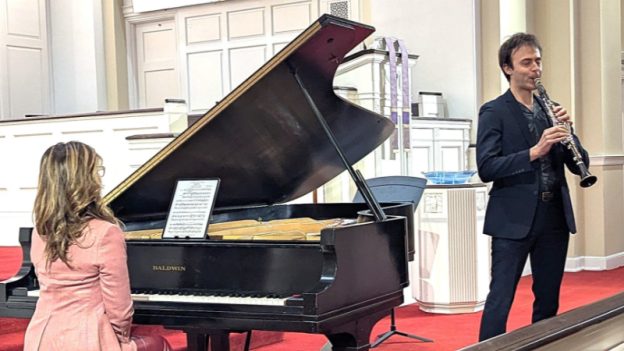
On Friday evening at Morningside Presbyterian Church in Atlanta, clarinetist Graeme Steele Johnson offered a thoughtfully constructed recital presented as part of the Nancy Frampton Rising Artist Series. The program traced an appealing arc across the clarinet repertoire, from early 20th-century French Impressionism to contemporary works before concluding with two central pillars of the Romantic literature.
Johnson opened with Michele Mangani’s arrangement of “Blues” from An American in Paris, adapted from George Gershwin’s 1928 orchestral score. Pianist Min Kwon joined him for the brief opener, which condenses Gershwin’s orchestral blues gestures into a nimble clarinet showpiece. Johnson navigated the piece’s jazzy inflections with rhythmic ease and a supple tone, shaping its phrases with a relaxed swing that suggested the orchestral original while maintaining the intimacy of chamber performance.
For the remainder of the evening, Johnson was partnered by pianist Minyoung Kang, beginning with Claude Debussy’s Première Rhapsodie. Written in 1910 as a Paris Conservatoire test piece, the work remains one of the defining compositions of the clarinet repertoire. Johnson approached it with an unforced lyricism, allowing Debussy’s long melodic lines to unfold naturally while keeping the tone light and flexible in the instrument’s upper register. Kang’s accompaniment was attentive and fluid, providing a gently shifting harmonic backdrop that helped sustain the work’s characteristic atmosphere.
A striking contrast followed in Katia Tchemberdji’s Sonata for Clarinet and Piano (1990), a work that resists the conventional hierarchy of soloist and accompanist. Instead, the sonata unfolds as a kind of dramatic conversation between the instruments, each voice alternately interrupting, shadowing, or reframing the other’s ideas. The clarinet often introduces sharply etched gestures—sometimes angular, sometimes lyrical—only to have the piano respond with commentary that alters the emotional perspective.
Johnson and Kang handled this interplay with a strong sense of character. Rather than smoothing the work’s contrasts, they leaned into them, allowing the abrupt changes of mood to register clearly. The effect was almost theatrical at times, with the clarinet projecting a distinct personality while the piano responded in ways that felt more like detached dialogue than accompaniment, revealing the sonata as a piece of considerable imagination.
After the intermission came Viet Cuong’s Apparition (2017), a short but striking contemporary work for unaccompanied clarinet that makes imaginative use of multiphonics—sounds produced by coaxing the instrument to speak in more than one pitch simultaneously. In much mid- to late-20th-century repertoire, such effects often appear as abrasive or deliberately destabilizing sonorities. Cuong, by contrast, deploys them with a more overtly musical intent, shaping them as resonant, almost luminous textures that emerge organically from the instrument.
Johnson rendered these passages with impressive control. The multiphonics sounded remarkably centered and attractive, more like layered harmonies than disruptive noise, blending convincingly into the piece’s evolving soundscape.
With Kang returning to the piano, the program’s final portion turned to the core Romantic repertoire. Robert Schumann’s Fantasiestücke, Op. 73 offered three concise character pieces whose lyrical impulse suited Johnson’s warm, rounded tone. The clarinet lines unfolded in long arcs while the piano provided a gently animated foundation.
The evening concluded with Johannes Brahms’ Sonata for Clarinet and Piano in E-flat Major, Op. 120, No. 2, one of the composer’s late chamber works written for the clarinetist Richard Mühlfeld. In contrast to the virtuosic display pieces often associated with the instrument, Brahms’ sonata favors introspection and conversational balance between the performers.
Johnson approached the work with measured restraint, allowing its reflective qualities to emerge naturally rather than pressing for overt drama. Kang matched that sensibility with playing that was both supportive and responsive, maintaining a finely judged balance between accompaniment and partnership.
Taken as a whole, the recital offered a rewarding survey of the clarinet’s expressive possibilities. From Gershwin’s jazz-tinged idiom through Debussy’s impressionistic colors and the distinctive voices of Tchemberdji and Cuong, the program moved comfortably across stylistic boundaries while keeping the clarinet’s expressive, lyrical character at the center. ■
EXTERNAL LINKS:
- Graeme Steele Johnson: graemesteelejohnson.com
- Minyoung Kang: musiciansclubofny.org/biographies/minyoungkang
- Min Kwon: pianistminkwon.com
- Nancy Frampton Rising Artists Series: morningsidepc.org/nfras

Read more by Mark Gresham.

.png)