
May 19, 2026
First Baptist Church of Decatur
Decatur, Georgia – USA
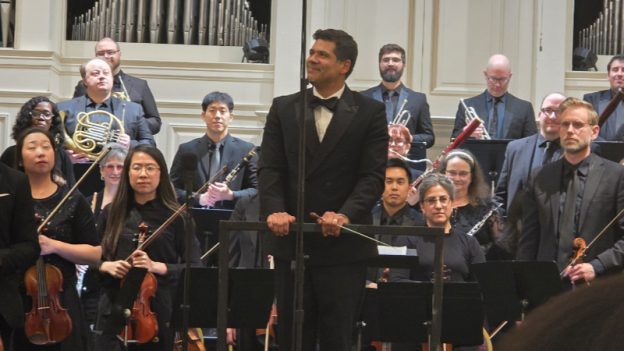
DeKalb Symphony Orchestra, Paul Bhasin, conductor; George Yancy, narrator.
Ottorino RESPIGHI: Antiche danze et arie per liuto (“Ancient Airs and Dances”) Suite No. 1, P 109
Joel THOMPSON: To Awaken the Sleeper
Edward ELGAR: Variations on an Original Theme, Op. 36 “Enigma Variations”
William Ford | 23 MAY 2026
The DeKalb Symphony Orchestra closed its season with an ambitious and intellectually engaging program led by music director Paul Bhasin, whose work at Emory University has helped strengthen ties between the orchestra and Atlanta’s broader academic and cultural community. Pairing the luminous nostalgia of Ottorino Respighi’s Ancient Airs and Dances, the socially charged theatricality of Joel Thompson’s To Awaken the Sleeper, and the deeply personal portraits of Edward Elgar’s Enigma Variations, the concert explored questions of memory, identity, and orchestral storytelling across more than a century of musical language.
Respighi’s Ancient Airs and Dances transforms Renaissance and Baroque lute melodies into richly colored orchestral miniatures filled with elegance, warmth, and atmospheric orchestration. Respighi, sometimes aptly described as a “Technicolor composer,” was less interested in historical authenticity than in reimagining older music through the lush sonorities of the modern orchestra. The performance emphasized the music’s rhythmic vitality and theatrical color, though the church’s acoustic immediately presented challenges.
Loudness is often the enemy of subtlety and finesse, and the reverberant space compressed dynamic contrast while blurring the transparency essential to Respighi’s orchestral writing. The electronic harpsichord projected far more aggressively than a traditional instrument would have, contributing further to the accumulation of midrange sonority in a room already predisposed toward acoustic congestion.
Those same acoustical issues became even more consequential in Joel Thompson’s To Awaken the Sleeper, the emotional and conceptual centerpiece of the evening. Composed in 2021 and drawing upon the writings of James Baldwin, the work examines identity, injustice, and moral awakening in contemporary America through a combination of spoken narration and highly theatrical orchestral writing.
Thompson’s musical language proved direct, forceful, and unapologetically rhetorical. Fragmented Ivesian gestures emerged from the orchestra only to be interrupted by brass proclamations, martial rhythms, and sharply dissonant interjections. Snare drums and timpani punctuated the score with ominous insistence, while recurring brass fanfares sounded less celebratory than accusatory.
The narration was delivered by George Yancy, professor of philosophy at Emory University. Using a microphone with remarkable clarity and articulation, Yancy projected Baldwin’s words with commanding presence and intellectual gravity. In a room where orchestral detail could easily blur into reverberant mass, the precision and immediacy of his spoken delivery became an anchoring force within the performance.
At several points, Thompson appeared to invoke fragments of American musical identity itself, including passages suggestive of “Johnny Comes Marching Home,” though distorted through orchestral fragmentation and dissonance. The work rarely sought comfort. Even its lyrical passages carried unease rather than release, at times recalling the uneasy reflective episodes that appear in Dmitri Shostakovich. Thompson’s writing favors dramatic immediacy over subtle abstraction, and the piece’s sense of urgency remained unmistakable throughout.
Here, the church’s acoustics both magnified and complicated the experience. The reverberation intensified the work’s already dense brass and percussion writing, creating climaxes of overwhelming physical force. A terrifying bass drum strike near the work’s climax landed less as orchestral punctuation than as an almost architectural event within the room itself. Yet the same acoustic excess that heightened the theatrical impact also reduced textural clarity and dynamic gradation. The music’s relentless pressure occasionally became generalized into sheer sonic mass.
Still, To Awaken the Sleeper emerged as the evening’s most compelling and fully realized performance precisely because Thompson’s compositional approach could absorb that excess. The work’s aggression, fragmentation, and rhetorical directness seemed strengthened rather than undermined by the environment surrounding it.
Elgar’s Enigma Variations presented a different challenge altogether. Unlike Thompson’s score, Elgar depends heavily upon orchestral blend, dark string sonority, layered inner voices, and carefully graded dynamic shaping. The opening theme lacked the diaphanous mystery and rich string warmth necessary to establish the work’s atmosphere, with woodwinds and horn accents often emerging too prominently from the orchestral fabric. At times, the brass, timpani, and percussion projected with an aggressiveness that compressed the work’s dynamic gradations and reduced some of Elgar’s carefully layered orchestral writing to generalized impact.
As the performance progressed, however, the orchestra settled more comfortably into the score, and several middle variations displayed improved cohesion and stronger dynamic pacing. “Nimrod” was taken at a notably broad tempo, emphasizing majesty over flow, yet the final statement of the theme achieved an appropriately grand sense of arrival.
The orchestra’s principal players consistently provided some of the evening’s strongest moments, particularly in the viola, bassoon, cello, and clarinet solos, all of which brought welcome individuality and warmth to the performance. Indeed, the orchestra’s greatest strength often appeared to reside in its individual instrumental voices rather than in full orchestral integration.
The physical arrangement of the orchestra likely contributed significantly to the balance problems heard throughout the evening. Positioned on an elevated rear platform directly in front of the organ façade and reflective architectural surfaces, the brass section projected with amplified brilliance and weight into the nave. The string sections, seated fully exposed at floor level without comparable reinforcement, often struggled to project equivalent warmth and depth.
This arrangement also likely made it difficult for the brass players to hear the strings clearly and adjust balance accordingly, contributing to an orchestral texture that frequently favored brass and percussion over subtler inner detail.
The sanctuary acoustic was designed primarily for the projection and clarity of the human voice, where midrange reinforcement is desirable. Orchestral music, however, depends equally upon blend, transparency, and dynamic nuance. Combined with the elevated reflective placement of the brass section, the room’s strong midrange emphasis often produced a dense and occasionally stressful orchestral sound.
As noted in previous DeKalb Symphony performances, the church’s acoustic remains a persistent obstacle. No matter how thoughtfully interpreted or carefully played the performances may be, the acoustical environment consistently works against orchestral nuance, flattening contrast and limiting the listener’s ability to fully appreciate subtler aspects of color, balance, and phrasing. The unusual acoustical characteristics of the sanctuary may also require ongoing adjustments from the listener’s perspective within the hall itself, where balance relationships can differ substantially from what is heard onstage.
One suspects this is a finer orchestra than its current home consistently allows listeners to hear. A venue with more accommodating acoustics, such as the Schwartz Center at Emory, might better reveal the ensemble’s refinement, balance, and individual artistry. ■
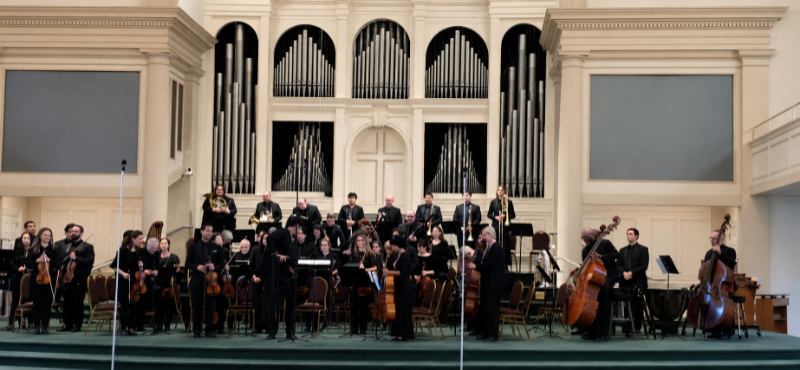
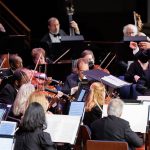
DeKalb Symphony Orchestra at First Baptist Church of Decatur, May 2026. (credit: William Ford)
EXTERNAL LINKS:
- DeKalb Symphony Orchestra: hdekalbsymphony.org
- Paul Bhasin: music.emory.edu/people/biography/bhasin-paul.html
- George Yancy: georgeyancy.com

Read more by William Ford.

.png)