
May 22, 2026
Symphony Hall
Atlanta, GA – USA
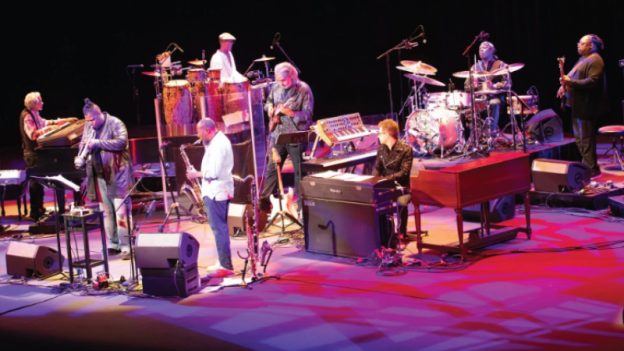
Keyon Harrold, trumpet; Antione Roney, saxophone; Robert Irving III, piano and electronic keyboards; Greg Spero, electronic keyboards; Jean-Paul Etienne Bourelly, guitar; Darryl Jones, bass; Munyungo Jackson, percussion; Rasaki Aladokun, percussion; Jason Kibler a/k/a DJ Logic, turntables; Vince Wilburn Jr., drums.
Mike Shaw | 26 MAY 2025
This year marks the 100th anniversary of the birth of Miles Davis, arguably one of the most impactful figures ever in jazz. For most of his career, trumpeter Davis challenged the boundaries of musical normalcy with complicated melodies and harmonies, establishing with saxophonist John Coltrane and others in the mid-20th century, a new norm for playing “outside.”
Davis, like many musicians of his time, was fueled by drugs, initially heroin, which he kicked in the ’50s, but later, a period now referred to as his “electric period,” by cocaine, which marked his music with an aggressiveness and incredibly high energy. Consistent with the moniker for those years, his music shuns the traditional acoustic instruments for electronics, including keyboards, guitar, and bass, which are supported by pounding rhythms from an extensive percussion section, including congas, bongos, and timbales as well as the traditional drum set. He altered his own playing to a biting intensity, playing through such effects as wah-wah pedals and other electronic devices to create what has been described as a “distorted, psychedelic wall of sound.”
Celebrating his electric period legacy is a group called Miles Electric Band, now simply “M.E.B.” They are a fluid group, some who played with Miles, some newer advocates of the sound. For this year’s preamble to the Atlanta Jazz Festival, M.E.B. performed at Symphony Hall, where it has become a tradition to deliver an opening salvo to the Festival. Led by featured trumpeter Keyon Harrold, whose playing blends jazz, soul, hip-hop, and more to create a genre-defying sound, the band—trumpet, sax, two keyboardists, electric bass and guitar, and four percussionists, including one on turntables—defied the boundaries of virtually any genre for an emotionally charged, highly expressive, and improvisational tour de force.
M.E.B. famously rotates players, so different performances feature different combinations. The pre-festival Symphony Hall show included artistic director Vince Wilburn Jr. on drums, a Miles Davis alumnus; Keyon Harrold on trumpet; Antione Roney on saxophone; nusical director Robert Irving III, another Davis alumnus, on piano and electronic keyboards; Greg Spero on electronic keyboards; Jean-Paul Etienne Bourelly on guitar; Darryl Jones, a Miles Davis alumnus, on bass; Munyungo Jackson, another Davis alumnus, and Rasaki Aladokun, on percussion; and Jason Kibler a/k/a DJ Logic on turntables.
M.E.B.’s music has been defined as “controlled chaos,” but this attack on traditional musical norms was hardly chaotic. It was complex and dissonant, sometimes on the brink of discordant; it was fiery and riddled with complicated harmonies and unpredictable melodies. But there were also ascending passages, suddenly beautiful and reassuring, harmonies that would rise soothingly to a crescendo before being beaten back with more dissonance. And always, even in the tenderest moments, it was persistently intense. And while the solos were fearlessly improvisational, the structure was meticulously orchestrated, the band united in its execution, including planned accents, and entries and exits for the soloists.
The concert opened as it preceded, at breakneck pace, with relentlessly torrential trumpet and soprano sax solos, a hot-tempered guitar solo, and pounding rhythms, lines relying on chromaticism as the rule rather than a departure, and altered, unexpected harmonies and key changes to create rich, textured sounds full of unresolved tension. From start to finish, it was a relentlessly emotional performance, including passages where you could feel Davis’s agony and anger, a raging discomfort that seemed at times to be fighting with itself, if with brilliant intentionality.
Davis and his electric period are credited for creating the genre known as “jazz funk.” Certainly, he had always been known for playing beyond traditional harmonies and melodies, sounds that can be hard on the ears of people who find his type of jazz unsettling. But with the addition of the electronics, rock-pulsed guitar licks, and heavy African rhythms, “outside” hardly assesses Davis’s electric period, or the extremities to which these musicians take their tribute to him. The tension builds quickly and never fades, even in the less fiery passages, through marvelous structures of defying melodies and harmonies, driving, soaring, and never landing, taking us somewhere we didn’t expect to go through corridors of non-stop intensity.
In fact, the unyielding intensity might have been too much for some in the audience. A substantial number left before M.E.B. finished, including many who were seated nearest the stage. It couldn’t have been for lack of appreciation, only for relief. ■
EXTERNAL LINKS:
- Atlanta Jazz Festival: atljazzfest.com
- Miles Electric Band: mileselectricband.com

Read more by Mike Shaw.



.png)