
October 9, 2026
Sandy Springs Performing Arts Center
Sandy Springs, Georgia – USA
“Taking Flight”
Johns Creek Symphony Orchestra; Henry Cheng, music director; Simon Zhu, violin; The Michael O’Neal Singers.
Christopher Tin: Sogno di Volare (Dream of Flight)
Pyotr Ilyich Tchaikovsky: Violin Concerto in D major, Op. 35
Igor Stravinsky: The Firebird Suite (1919 version)
Howard Wershil | 13 OCT 2026
It’s always a pleasure to see a performing arts group grow and progress. This year marks the 20th anniversary of the Johns Creek Symphony Orchestra (JCSO), a fully professional, part-time symphonic orchestra serving metro Atlanta—and they’re certainly celebrating in a big way. Their season-opening concert, sponsored by Massey Charitable Trust, took place at the new Sandy Springs Performing Arts Center, a beautiful, acoustically excellent venue aptly suited to the occasion.
The first piece of the evening, Sogno di Volare (Dream of Flight), written by two-time Grammy Award-winning film and game composer Christopher Tin, was a spirited fanfare that ideally related to the concert’s “Taking Flight” theme. As an artfully rendered, inspiring work, it masterfully and delightfully provided exactly the excitement and listenability needed to launch the evening’s festivities. The Michael O’Neal Singers, a well-known, established, and thankfully persistent jewel of Atlanta’s rich music scene, provided the vocalelement. The JCSO’s rendition was satisfyingly energetic. The total experience was quite uplifting, exactly the direction one would hope to achieve when “Taking Flight.”
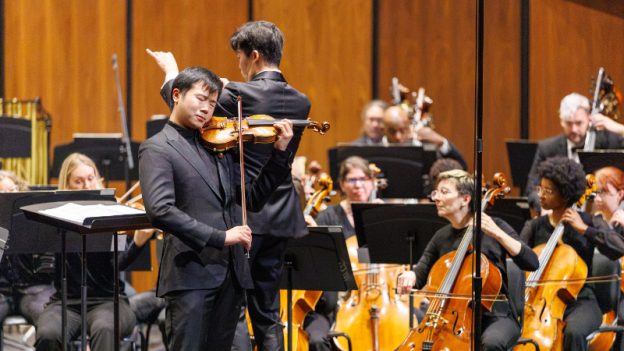
Pyotr Ilyich Tchaikovsky’s Violin Concerto in D major, Op. 35 is a familiar work in the collection of established orchestral classics. Its performance can be make-or-break, depending on the solo violinist’s skill, and young, multiple contest-winner Simon Zhu did not disappoint. Throughout all three movements, his performance was measured, brilliant, sensitive, exuberant… choose your own superlative adjective. I might suggest that such a refined performance can, depending upon the taste of the listener, occasionally detract from communicating the rawer and grittier emotions such a composition can evoke. A slight pause here, a gentle increase of bow pressure there, can potentially speak volumes. Such additional nuances may indeed have been present, but difficult to detect for an audience who, in such a grand performance space, cannot experience the intimacy within which such nuances better thrive. Taste is a matter of taste, of course, and a performance space is what a performance space is. Regardless, the astounding performance capabilities displayed by Simon Zhu definitely shone through any potential deterrent, and his rendition of Tchaikovsky’s masterpiece was superb.
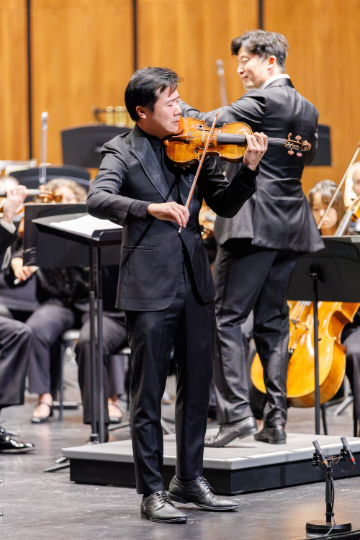
Violinist Simon Zhu and JCSO music director Henry Cheng. (credit: Ken Otloff)
An orchestra’s performance can be make-or-break as well. In this instance, the JCSO sparkled in its ability to move with the soloist’s demands, responding with complete musical confidence during the intervening passages as the soloist paused to gather energy and resolve.
In the first movement, “Allegro moderato,” Tchaikovsky gives us a lyrical theme, renders it prominent for both orchestra and soloist, and subtly varies it throughout the movement, offering both tender and dramatic interludes of accompanying material along the way, yet always returning to some version, identical or modified, of the central melody, bandied back and forth between soloist and accompanying orchestra. The overall effect, for me at least, is an experience of broadening perspective and ultimately, calm resolve.
The shorter second movement, “Canzonetta: Andante,” offers a lyrical, highly melodic, and colorful respite as preparation for the third movement, “Finale: Allegro vivacissimo,” which Tchaikovsky leads us into without pause. And extremely lively it is indeed! Out of the three movements, it could be argued that this final movement exacts the greatest demands on the violinist, with the most rapid, fiercest passages of the entire composition. Simon Zhu’s performance of these passages further cemented his reputation as a virtuoso, and the JCSO’s masterful, confident accompaniment emphasized their abilities as highly accomplished, tuned-in professionals. Of course, much of this credit must be attributed to music director Henry Cheng, whose positive influence behind the scenes will always be something of a mystery to us, while his self-assured ease and panache on the podium, and its marvelous effect on the music we’re hearing, will always be available to impress his audiences.
An amusing aspect to the performance of the Tchaikovsky was the audience offering a standing ovation… after the first movement! Whether this was the result of audience naivety or an appropriately rousing response to a superior rendition by both orchestra and soloist, I cannot say. Whatever it was, I’ll take it to be yet another example of the power of well-composed, moving orchestral music to spark passion in any appreciative listener, whether a seasoned aficionado or a new participant to the realm. Music director Henry Cheng did gently and jovially notify the audience that two more movements were about to be played (“And now, for the second and third movement!”), as one might think should be appropriate. The audience responded with light laughter, as might also be considered quite appropriate under such an entertaining situation.
After intermission, we were graced with the 1919 version (revised by the composer from the original 1910 version) of Igor Stravinsky’s youthful masterpiece, The Firebird Suite (L’Oiseau de feu). What other piece of music could so dramatically embody the concept of “Taking Flight”? Consisting of seven rather short movements, Stravinsky treats us with broad contrasts of drama, lyricism, orchestral density, and sonic color unheard of at the time of its creation. The JCSO provided us with an admirable, lively rendition, with the solo passages performed powerfully and sensitively by each of the instrumentalists charged with the task. This is a beautiful, exciting, moving composition, one I hope you take an opportunity to enjoy if you’ve not done so already.
Season 20 of the Johns Creek Symphony Orchestra, “Becoming,” is certainly off to a remarkable start, but there’s so much more to come. I’m so excited to see the direction they’re taking this year, both as a reviewer and especially as a composer and music lover. On November 14, as a project of NON/SENSE Arts Foundation, at LOOP, in conjunction with YouTube channel jazziRed and Kalamity Music, we’ll be treated to a “Soundcraft Symphonic Experience,” including a medley of epic music from Minecraft, a mechanized version of Terry Riley’s In C, and a rendition of Steve Reich’s Clapping Music. On December 5, at Innovation Academy, we have the JCSO’s not-so-traditional “Holiday Pops” concert, featuring familiar seasonal standards and unexpected surprises. Then, to complete the season, on April 10, 2027, at Johns Creek Baptist Church, in conjunction with Full Radius Dance, we’re offered “Music as Healing,” featuring the premiere of composer Mahlon Berv’s Grace: From Darkness to Light – Symphonic Suite, and the ever-popular Symphony No. 5 in C minor, Op. 67, by Ludwig van Beethoven.
Each year, the JCSO attaches a theme to its season and chooses a descriptor for each concert featured in that season. Its 20th season, “Becoming,” a word indicating phenomena of arrival, transformation, growth, and culmination—all of which aptly apply to the JCSO—is certainly an appropriate label on so many levels, with its acquisition of new artistic and financial partnerships and its exploration of new performance venues for orchestral performance notwithstanding. This is a group that shows mastery and sensitivity in dealing with established works but fearlessly explores new horizons as well. I’ve had the wonderful pleasure of reviewing the JCSO since January 2025. Should circumstances permit, I hope to continue those efforts and reap the pleasurable benefits.
When the JCSO is “Taking Flight,” I can’t wait to see what happens next! ■
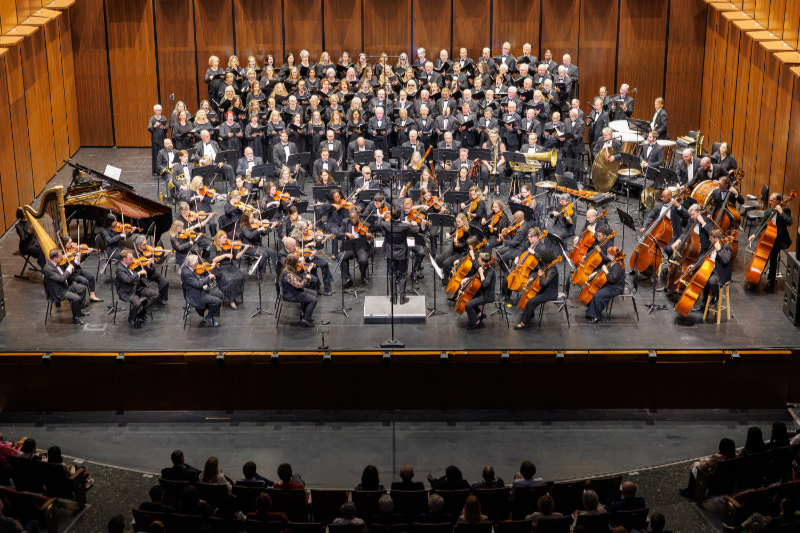
The Johns Creek Symphony Orchestra and The Michael O’Neal Singers together at the Sandy Springs Performing Arts Center, October 9, 2026. (credit: Ken Otloff)
EXTERNAL LINKS:
- Johns Creek Symphony Orchestra: johnscreeksymphony.org
- The Michael O’Neal Singers: mosingers.com
- Simon Zhu: simonzhu-violin.com
- Christopher Tin: christophertin.com

Read more by Howard Wershil.


.png)