

May 7, 2023
“Bent Frequency Celebrates 20 Years”
Kopleff Recital Hall
Atlanta, GA
Bent Frequency: Sarah Kruser Ambrose, flute; Jan Berry Baker, saxophone; Tamia Maxwell Clements, viola; Adelaide Federici, violin; Stuart Gerber, percussion; Ted Gurch, clarinet; Khesner Oliviera, percusaion; Brad Ritchie, cello; Erika Tazawa, piano. Atlanta Improvisers Orchestra: majid Araim, mandolin; William Barrow, synthesizer; Raelixe Cassette, baritone guitar; Alex Cohen, viola da gamba; Eric Fintaine, reeds; James Robert Foster, bass; David Gray, guitar; Joel Rust, guitar; Benjamin Shirley, cello; Priscilla Smith, flute;Beverly Sylvester, saxophone; Al-Yasha Ilham Williams, clarinet.
Alvin SINGLETON: Be Natural (1976)
Judith SHATIN: Of Wells and Springs (2023)*
Louis ANDRIESSEN: Worker’s Union (1975)
George LEWIS: Shadowgraph, 5 (1977, rev. 2021)
Raven CHACON: American Ledger No. 1 (2018)
*World premiere
Mark Gresham | 12 MAY 2022
Only a handful of days short of two decades, Atlanta-based contemporary music ensemble Bent Frequency celebrated the 20th anniversary of its debut concert, which took place on May 12, 2003, at Eyedrum Art & Music Gallery, located at the time in a warehouse at 290 Martin Luther King Drive.
A significant addition to Atlanta’s new music scene at the time, musicians Robert Ambrose, Nickitas Demos, Stuart Gerber, and Alexander Mickelthwate formed the ensemble. They presented an adventurpus program of six works by David Lang, John Luther Adams, Karlheinz Stockhausen, John Zorn, Anthony Davis, and the group’s own Nick Demos at that first concert. Fourteen musicians and two visual artists joined in as performers for the evening. Ambrose and Mickelthwate took turns on the podium, each leading three works.
Eyedrum was a deliberate venue choice for that first convert. In the weeks leading up to that debut, Mickelthwate said that the venue “gives us this kind of spin that we are more of an alternative band that is usually associated with the independent scene.” Ambrose echoed the premise: “We want all of the stuffiness out of it,” wit the hopes of achieving elements of “almost a rock concert” atmosphere. The ensemble’s debut overall proved an enjoyable musical success, and the atmosphere was, as intended, not stuffy, which helped draw and hold an intrigued crowd.
In contrast, Kopleff Recital Hall, on the downtown campus of Georgia State University, was the location for Sunday’s 20th-anniversary concert, “Bent Frequency celebrates 20 years,” where the group was joined on the second half by the Atlanta Improvisers Orchestra, for a total of 21 musicians participating in the celebration. Because Bent Frequency is now an ensemble-in-residence at GSU, Kopleff Hall is an easy choice for their concerts versus securing an independent venue, although Bent Frequency did perform at the newest Eyedrum location back in December.
Percussionist Stuart Gerber, a professor at GSU School of Music, is the only remaining member of the original Bent Frequency group and shares its co-artistic directorship with saxophonist Jan Berry Baker, who was also part of the GSU faculty with Gerber but is now a professor of saxophone at UCLA’s Herb Alpert School of Music.
The group has gone through some changes, some ups and downs, over its 20-year lifetime. Today, while still avant-garde in intent, it now leans more toward DEI (diversity, equity, inclusion) in its programming choices, consistent with the times. Its presentations also seem at times more formal than the original “almost a rock concert” precept. They have just introduced a new, cleanly elegant, modern-minimal Bent Frequency logo, which also seems to reflect that versus a raw, edgier, independent image. But what does remain consistent with its beginnings is the high quality of Bent Frequency’s performances.
Bent Frequency performed five works in Sunday’s program by composers Alvin Singleton, Judith Shatin, Louis Andriessen, George Lewis, and Raven Chacon.
The concert opened with Be Natural (1976), an early work for any three bowed string instruments by Atlanta-based composer Alvin Singleton. Born in Brooklyn, New York, Singleton completed his studies at New York University and Yale. Then as a Fulbright Scholar, he studied at Accademia Nazionale di Santa Cecilia in Rome, Italy. After living and working in Europe for 14 years, Singleton returned to the United States to become composer-in-residence with the Atlanta Symphony Orchestra from 1985 to 1988. Rather than move elsewhere afterward, Singleton has resided in Atlanta ever since. He is now the estemed elder statesman among Atlanta composers.
Be Natural was performed by violinist Adelaide Federici, violist Tania Maxwell Clements, and cellist Brad Ritchie. The score features improvisation, calling for the musicians to play a game involving musical elements which, except for the pitch B♮ (the one immediately below middle C) expressed in a non-traditional notation involving pictograms in various boxes. All three musicians do sound the B♮ together at both the beginning and end, but throughout the piece, the B♮ drone must always be played by at least one musician, with improvised passages played against it by the other musicians.
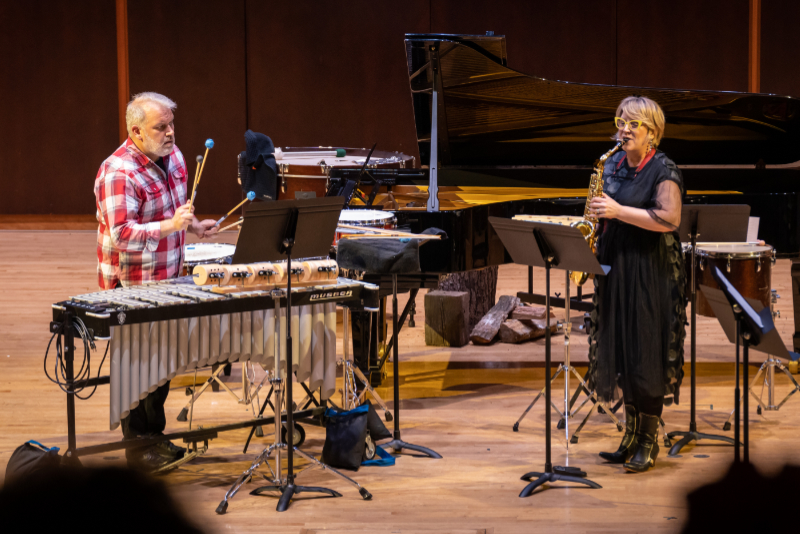
Percussionist Stuart Gerber and saxophonist Jan Berry Baker perform the world premiere of Judith Shatin’s “Of Wells and Springs.” (credit: Steve Eberhardt)
Next, Gerber and Baker, as the Bent Frequency Duo, a touring subset of Bent Frequency, performed the world premiere of Of Wells and Springs by Judith Shatin, for alto sax and percussion, commissioned in a consortium between the Duo and saxophonists Nicole M. Roman and Drew Whiting. The topic of water arose in the initial conversations between the composer and Bent Frequency Duo. Of Wells and Springs takes its title from the poem Water by environmentalist Wendell Berry. especially evocative of water was he interplay between saxophone and vibraphone in the piece.
New music groups in Atlanta have performed Louis Andriessen’s Workers Union than one might imagine. I believe I’ve heard it programmed a handful of times. In the piece, there is freedom for individual players in terms of pitch, which is only relative, notated on a single-line staff. On the other hand, its rhythm is precisely fixed. What stood out in this particular performance, played by all nine Bent Frequency musicians, was an exciting treatment of musical phrasing versus previous ones I’ve heard by different groups that seemed to be merely loud. Here we could experience an overarching dramatic forward motion in the piece rather than just the procession of lockstep rhythms. That made for perhaps the most musically engaging local performance I have heard to date.
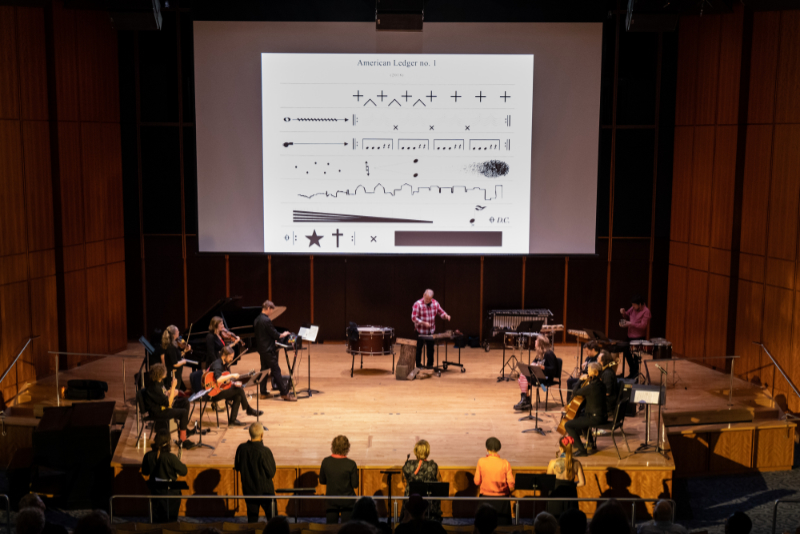
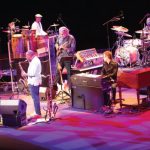
The combined forces of Bent Frequency and Atlanta Improvisers Orchestra perform “American Ledger No. 1” by Raven Chacon. (credit: Steve Eberhardt)
After intermission Bent Frequency and the Atlanta Improvisers Orchestra joined forces for the program’s two final works: Shadowgraph, 5 by George Lewis and American Ledger No. 1 by Raven Chacon.
Formed in 2018, the Atlanta Improvisers Orchestra describes itself as “a supergroup of members of Atlanta’s cutting-edge experimental music scene, united by composer Ofir Klemperer to explore the possibilities of large-group musical improvisation.”
Shadowgraph, 5 is the last in a series of five works composed by George Lewis between 1975 and 1977 (this one revised in 2021) with no centralized score for any number of instruments in any combination without a conductor, nor must all of the parts be used in performance (but at least one), and the length of the performance is indeterminate (the performers deciding on the duration), according to the composer’s program notes. Otherwise, it is difficult to say what the piece should sound like, as there are a plethora of possibilities. One can speculate that much of it depends on the number of musicians and types of instruments involved, so what we got was more of an impression of the sonic scope of the 21 musicians involved than an identifiable composition per se.
In contrast, Raven Chacon’s American Ledger No. 1 is an intentionally narrative piece, a socio-political statement, as the composer puts it in his program notes: “telling the creation story of the founding of the United States of America. In chronological descending order, moments of contact, enactment of laws, events of violence, the building of cities, and erasure of land and worldview are mediated through graphic notation and realized by sustaining and percussive instruments, coins, axe and wood, a police whistle, and a match.”
Originally from Fort Defiance, Navajo Nation, Chacon was the recipient of the 2022 Pulitzer Prize for Music. The simple graphic score for his American Ledger No. 1 was projected on a giant screen at the back of the stage, from which all musicians played. The music had a certain appealing directness about it, whether you chose to relate it to its extra-musical message or not. ■
EXTERNAL LINKS:
- Bent Frequency: bentfrequency.com
- Atlanta Improvisers Orchestra:
atlimprovorch.org - Alvin Singleton: alvinsingleton.com
- Judith Shatin: judithshatin.com
- Louis Andriessen: boosey.com/composer/Louis+Andriessen
- George Lewis: music.columbia.edu/bios/george-e-lewis
- Raven Chacon: spiderwebsinthesky.com

Read more by Mark Gresham.
.png)