

PART 2
Continued from PART 1.
MG: Does the aesthetic itself change with the changes in technology? TIf you see something new in technology or find a new way of using an existing technology, does that change the aesthetic in terms of the possible? Does it reset your mind in some ways about designing a set?
ER: I do think that any kind of change affects us and the choices that we make, even unconsciously. For example, I’ve noticed that in drafting. I started off in the days of hand drafting. By the time it got to around 2003 or so, everybody had started to do computer drafting. What’s interesting is that there are still a lot of things you can’t really do the same way with computer drafting that you can do with hand drafting. There are things you have to draw or find ways to illustrate, like a tree or any organic shapes. The computer does these sorts of straight lines very, very well. It doesn’t do the organic things as well. When people try to draw with a computer, try to draw a tree, it ends up starting to look very odd.
And I think it affects design because I’ve noticed, especially when I see people who have never done anything but computer drafting, that technology starts to affect their choices because they’re making choices based on what the computer does more effectively. You see fewer organic things. I don’t know if that’s a conscious choice, but it’s possibly evolved because of that.
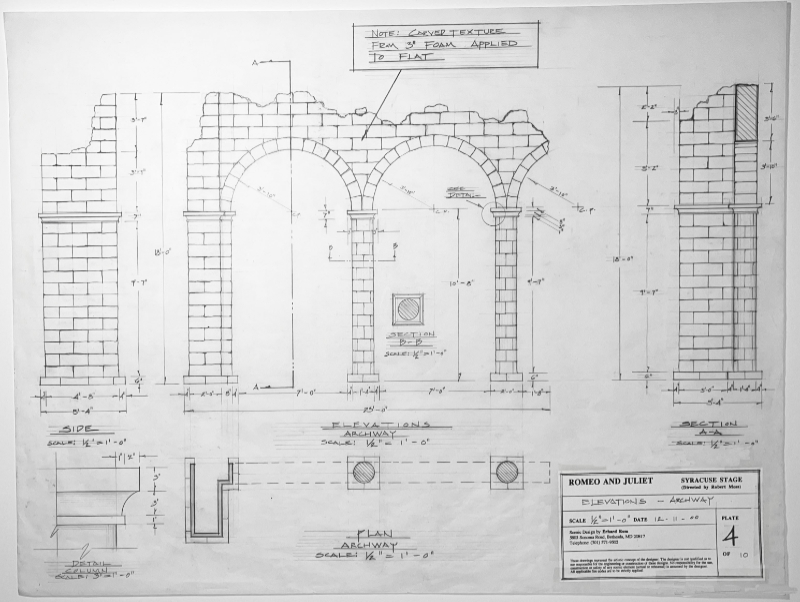
Example of Erhard Rom’s hand-drafting: elements of a set for “Romeo and Juliet.” (courtesy of Erhard Rom)
MG: I’ve discovered the same thing with music composition. You get students accustomed to synthesis from their laptops, digitally emulating instruments, but they don’t have experience with the actual instruments. The software itself encourages a particular direction in elements of style. So you have to question whether a new technology pushes you towards a particular style in stagecraft. It could be specifically projection, but I am also assuming that projection is not the only place where technological advances have come about.
I remember, again from the mid-1970s, seeing the Harold Prince production of Candide, with the remarkable environmental set by Eugene Lee, which blew me away as a teenager.
ER: It’s interesting that you bring him up. I actually assisted him for a while when I was a student. I found him very inspiring. My main teacher, though, was John Conklin at NYU. He was also a huge inspiration, much more so than Eugene Lee, because my time with Lee was short. John’s approach was always very much based on dramaturgy. That’s how I connected with him because that made sense to me, and it does to this day that everything you do has to come out of the heart, the humanity of the music, and the story you’re trying to tell in the case of opera. Technology is great, but you can’t let it control you. You need to control it. In some ways, there’s no way it can control you unless you just shut down and stop thinking.
That brings up the questions and current discussions about artificial intelligence. My feeling about that is that none of these things remove the tools that were there before. You still need to be able to draw and paint, PhotoShop doesn’t replace painting and drawing. Computer drafting doesn’t really completely replace hand drafting because there’s still things you have to draw. You have to come back to recognizing that as these things evolve, they become additional tools that we can use.
I feel the same way about the artificial intelligence discussion, that these are just new tools. It’s not like a person isn’t telling them what to do. Artificial intelligence is not innovative. It can take Beethoven and make something that sounds like that, but that’s all it’s doing is kind of mixing things up that you tell it to do. I’m sure that we’ll be able to use that technology someday in ways. I haven’t even had anything to do with that yet. But if, if I do, I’m sure it’ll be a tool that will be just another tool like everything else. What you do with it is what’s going to matter.
Just as I said with the whole thing about cinema, initially anybody can make a train driving at the audience and make a huge impact. “Oh my God, they’re jumping out of their chairs. They’re terrified.” But once that wears off, what are you gonna put on the screen?
Now, you need to have somebody thinking about more than just the fact that they can do that. So, with projections and so forth, it still comes back to what is the heart of the story. What is the drama? What is the emotion? What is the psychology? What do you want to express? We have the technology to do it better and better, but that doesn’t change the core. That’s the part that interests me so much. What makes somebody a Mozart? Why is there such a difference between what a lesser composer writes and what a great composer writes? They invent this harmonic language, they invent these melodies. There’s a magical place where that just comes from in the arts—we don’t know where. And to me, that’s infinitely fascinating but also hopelessly unanswerable.

Example of computer drafting: Walls and French doors for “the Marriage of Figaro,” San Francisco Opera. (courtesy of Erhard Rom.)
That’s the same with digital technology and projections. At the end of the day, it’s great to have the ability to have these tools, but it’s going to be about what people do with them that will make a huge difference down the line because that’s what people are there to experience the emotions of the piece. And that’s what your job is, ultimately, to communicate with people with whatever tool you’re using.
I often say this: I never really want the show to be all driven by projections. It’s really hard for me as a scenic designer because I love the live event and being in the room. And I love that it opens up the possibility of using techniques that you could only do in cinema. But at the same time, I don’t really want it to take over 100%. It’s another part of the expressive possibility. It’s like an orchestra where you have all these instruments, and suddenly you’ve developed the trombone. Well, that doesn’t mean the trombone has to play all through the symphony; it plays when needed.
When creating the projections and scenic design, I can always make that judgment. From a totally artistic point of view, I’m going to choose to use video when it’s needed and not use it when it’s not needed.
I can say this because I’ve worked with projection designers who are hired to do only the projection design. I often sit there, thinking, well, there’s no need for projection of this part. They sometimes have a hard time if they’re hired to do that; they feel like they need to be doing something. But it’s hard to recognize when all you’re working on is that part of the project.
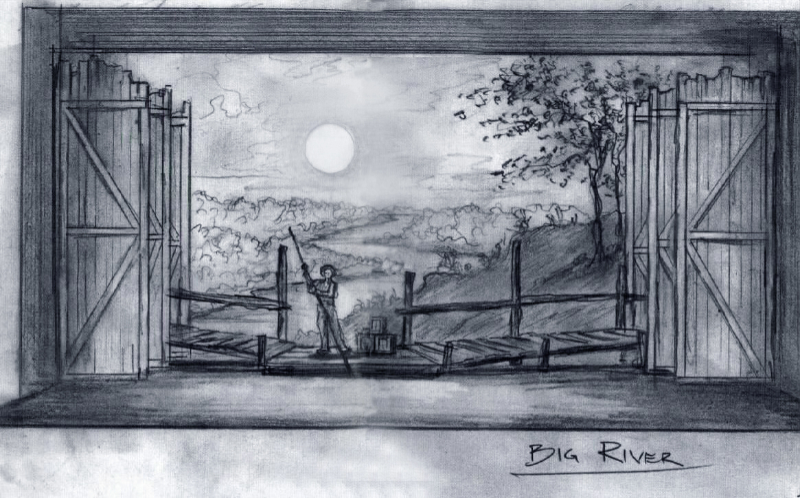
A sketch for the set of the musical “Big River: The Adventures of Huckleberry Finn.” (courtesy of Erhard Rom)
That comes back to the artistry, the dramaturgy, the storytelling. What’s the music going? What does it need? The piece tells you what it needs. We are working with these brilliant operas, and they tell you what they need if you just listen.
MG: We haven’t talked much about three-dimensional mechanical elements set design and what advances have taken place in that area. Do you have something really important to say about physical stagecraft and design?
ER: There’s one thing I would say about early stage design for the proscenium theater, specifically. You made comments about that Bergman Magic Flute, which was filmed in a replica of the Drottningholm Palace Theatre, not the actual one. I was recently working in Stockholm, and Drottningholm is near there. I’ve been in that theater and it really is a theater designed in the old fashioned Baroque style with borders and legs as scenic elements.
So it’s layered. Flat, painted scenes layered back [for] perspective. So the king sits in the middle and gets the perfect view, and everybody else sees it slightly skewed. It was all about these like flat painted images layered into a proscenium with a backdrop, legs and borders, the wings, and drop scenery.
That all began to change in the 20th century, as more and more scenery shifted to become three-dimensional, and it became, as scenic designers early on would do renderings, often would do paintings. I still did sketches and paintings early on in my work even. But because it was, and still is, part of what the training should be.
But three-dimensional scale models became a absolute necessity. By the 1970s, 80s, and 90s, everybody made models of scenery, and scenery became much more three-dimensional. Starting in the seventies, it was widespread, but occasionally, you would see painted flats. Even today you might see that.
What I find interesting about that evolution is that with recent advances in technology, strangely, I sometimes feel like we’re going back to that in a new way because now you can have a series of borders that are LED walls, and in the backdrop, you could create flat surfaces with projected imagery that’s essentially flat in a cut-out three-dimensional way that almost feels like going back to the old style.
I also think about the way designs were presented. I used to make package models and bring them to a meeting when we were presenting the design, and there would be this model in the room, and you light it up, and people would come and look into it and see what was there. Over time, I would take digital pictures of the model, and then I would do Photoshop work on the model pictures and present all the scenes, and that became more and more to the point where now you do 3D virtual models. I literally make a model of the set in my studio. However, I also have an assistant create a virtual 3D model that becomes a way to present the design.
So it’s almost like we’ve made full circle, like the old-fashioned way where you do a painted rendering of your set. Now, you can create all these digital images of a virtual 3D model and present them to people on Zoom. It’s almost like technology has brought us back to using some older conventions in a brand-new way. While we think we’re going forward, we’re also going back at the same time, taking some things from the past and bringing them into the future in a newly rethought way.
MG: As you said, the two are one thing, extensions of each other.
ER: Again, scenic design has evolved into a much more architectural kind of space. I’ve totally embraced that, and I’m never going to let go of it because I feel like that makes it exciting for an audience to be in a room with real things. But to be able to project in addition to having the architectural space is exciting to me. ■
EXTERNAL LINKS:
- Erhard Rom: aso.org
- The Atlanta Opera: williamrlangley.com

Read more by Mark Gresham.
.png)