
Kurt Loft | 9 MAR 2026
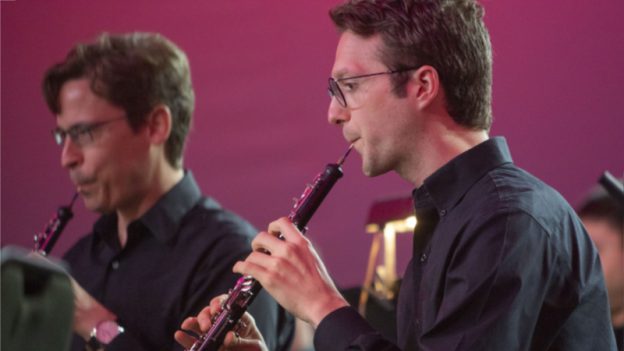
Mitchell Kuhn would have made a good auto mechanic—he’s an expert at tuning up. But he chose a different path as a musician, recently landing a new position as principal oboe with The Florida Orchestra.
Now he keeps the orchestra running smoothly with a tune-up every time he performs. Before each concert, he sounds a piercing A note on his oboe, and all the musicians synchronize to the pitch.
“I suppose there’s a small amount of pride in getting to do it,” Kuhn said of his curtain-raising job, “but it mostly feels like it’s simply the duty of the oboist.”
Why the oboe and not the clarinet, trumpet, or violin? The oboe’s double-reed design makes its pitch difficult to adjust on demand. But more importantly, its nasal sound penetrates the air like a knife, providing a reliable reference for everyone on stage.
“There is credence to the idea that the oboe’s tone is just a little more piercing than some other instruments,” Kuhn said.
Oboists are a special lot. Not only is the instrument finicky (some say it has a life of its own), but it also requires intense breath control and sustained air pressure, complicated fingerings for two dozen keys, and a demanding embouchure.
This creates a steep learning curve for beginners, a reason many potential oboists switch to other instruments. Kuhn did the opposite.
“I initially picked the clarinet because my favorite television show was SpongeBob SquarePants, and one of the characters plays the clarinet,’’ he said. “But in the sixth grade, my band teacher played a recording of Holst’s The Planets, and I heard the oboe for the first time and immediately fell in love with it.”
His teacher at Douglas Anderson School of the Arts in Jacksonville wasn’t so sure. It would require a serious commitment that young people aren’t always willing to make.
“I begged my band director to let me play the oboe, but he didn’t really encourage it since he knew how difficult and fussy an instrument it was,” he said. “But I persisted, and he eventually brought one in for me to try. I instantly connected with it.”
Kuhn soon found a tutor and began studying under Eric Olson, principal oboist of the Jacksonville Symphony. After graduating from high school in 2013, armed with his chosen instrument and plenty of confidence, Kuhn immersed himself for six years at the Juilliard School of Music in New York, where he earned a bachelor’s and master’s degree in music.
A prestigious job offer followed: acting principal of the Metropolitan Opera Orchestra, as well as occasional gigs with the Minnesota Orchestra, New York Philharmonic, Lyric Opera of Chicago, Marlboro Music Festival, Jacksonville Symphony, and Sarasota Orchestra. Then came a call from TFO Music Director Michael Francis and a position with the state’s largest performing arts organization, which he “accepted immediately,” knowing that full-time chairs as a principal player aren’t easy to land.
“Winning a position in an orchestra is very difficult,” the 31-year-old said. “I’ve taken close to 30 (auditions) and have won two. Some people take 50 before winning one, and some people never do, despite being amazing musicians.”
Oboe jobs in major and regional orchestras are highly competitive, but after a probation period of one to three years, a player can enjoy a long, tenured career. The instrument is integral to the blend of the woodwind section, and with its 400-year history, the oboe is found in virtually all orchestral repertoire.
But it would ring hollow if not for two fragile strips of grass that most oboists must meticulously bend to their will: the double reed.
“It’s far and away the most challenging, perplexing, vexing, frustrating, and difficult part of playing the oboe,’’ Kuhn said. “I spend a significantly larger amount of time making reeds than I do practicing, often hours a day if I’m needing a large quantity of great reeds.”
Unlike a single reed used in the clarinet, oboes require two that vibrate together as a mouthpiece. The player must blow a pressurized stream of air through a tiny opening between the reeds, holding their breath and releasing air at a slow, controlled rate − producing sound wholly dependent on the quality of the reed. Oboists are famous for stories about headaches from exhaling and heartaches from an erratic mouthpiece.
The reeds are made from the bamboo-like arundo donax, a perennial grass commonly called a cane. It must be harvested, dried, seasoned, and then processed (gouged, shaped, and gouged again) over a long period. Performers must also soak and dry their reeds before playing, and because they absorb moisture from the air—especially in Florida’s high humidity—reeds are prone to expand. So, there’s no guarantee they will cooperate during an Albinoni oboe concerto, much less a Mahler symphony.
“You have to balance what reed you want to use where or for what piece, and you have to calculate when you’re going to soak that reed for optimal results,” Kuhn said. “If the reed is too dry, it will sound shallow, bright, and soft, and won’t readily respond. If it’s over-soaked, it may sound flat, tubby, or spitty.”
All this uncertainty can give a player the jitters before walking onto the concert stage.
“The happiness of many an oboist is completely dependent on their reeds,” he added. “I try very hard to not let my reeds affect my mood, but it’s gotten better as I get older and better at making them. Even professionals in their 50s and 60s, masters of their craft, are still chasing the perfect reed.” ■
The Florida Orchestra’s next Masterworks program includes Mozart’s Symphony No. 41, Shostakovich’s Cello Concerto No. 1 with soloist Maximilian Hornung, and Beethoven’s Grosse Fuge. March 21, 8 p.m., Mahaffey Theater, 400 First St. S., St. Petersburg, and March 22, 2 p.m., also at Mahaffey. Tickets: www.floridaorchestra.org
EXTERNAL LINKS:
- The Florida Orchestra: floridaorchestra.org

Read more by Kurt Loft.




.png)