

March 20 & 21, 2026
Meymandi Concert Hall
Raleigh, North Carolina — USA
North Carolina Symphony; Carlos Miguel Prieto, conductor; Anne-Marie McDermott, piano.
Ludwig van BEETHOVEN: Piano Concerto No. 5 in E-flat Major, Op. 73 “Emperor” (1809)
Béla BARTÓK: Concerto for Orchestra, BB 123 (1942–43)
Christopher Hill | 24 FEB 2026
On the weekend of 20–21 March 2026, the North Carolina Symphony, under the direction of Carlos Miguel Prieto, presented two works that helped define the music of their time: Beethoven’s Fifth Piano Concerto, op. 73, nicknamed “the Emperor,” and Bartók’s Concerto for Orchestra, imperious in its own way.
In a pre-concert chat, Prieto said that with its performance of the Bartók Concerto, the North Carolina Symphony was “raising the bar.” How so? Well, what would make an orchestral piece a concerto? Lots of exposed and difficult solos, for one thing, in all sections of the orchestra. Every musician in the ensemble has to come with their A game — unless they enjoy being embarrassed.
The original 1925 notion of a concerto for orchestra was Paul Hindemith’s — not surprisingly, since he was at the very least a competent and often a very good player of many orchestral instruments. Hindemith’s idea took off almost immediately. By the time Boston Symphony Orchestra music director Serge Koussevitsky agreed to let Bartók try his hand at one, at least fourteen other such works had already followed Hindemith’s original, including a 1939 Concerto for Orchestra by Bartók’s lifelong friend Zoltan Kodály. Many of these earlier concertos for orchestra may be just as worthy as they are generally unknown. But in terms of regular performances, only Bartók’s can be called a worldwide hit. He virtually owns the genre.
So what did he do right? Basically, he found a way to appeal to American audiences while remaining true to himself. He was a composer who, in the positivist spirit of his age, enjoyed playing number games with musical notes. But he was also a composer who somehow was able to mix such ludi tonalis with deep dives into the human shadow, retrieving more vividly than almost anyone else screams, cries, and similar expressions of extreme human emotional states. Bartók was also a composer passionate about the songs and dances of ordinary rural folk in his region, music quite different from the gypsy idioms that Liszt and Brahms had called “Hungarian.”
The Concerto for Orchestra displays all these characteristic Bartók traits, but it mixes them with passages featuring simpler styles and tunes, the type unsophisticated audiences prefer. The mix is a superior one, in your reviewer’s occasionally humble opinion. The recently “terminated” Boston Symphony Orchestra gave the Concerto its premiere on 1 December 1944, when the work proved a success. Bartók revised it in February 1945.
There was a time when Fritz Reiner’s interpretation of the Concerto provided the benchmark against which all other performances were (negatively) judged. Time has diluted critical bile a bit, and today it is possible for a conductor like Prieto to make Bartók’s work his own. As is typical for this orchestra under this conductor, balances were finely judged, and textures were remarkably transparent, despite Bartók’s penchant here for impressionistic polytonal underbrush. Outbursts are frequent in this music, and they never lacked for fervor. If some plangent passages were less soul-wrenching than in some performances your reviewer remembers, the passages were nevertheless rendered with energy and sincerity. This is, after all, an ensemble of mostly young players, many of whom have not experienced the cultural tragedies that plagued Europe during the first half of the twentieth century. Give them ten years, and they’ll understand those tragedies better.
In his pre-concert chat, the maestro mentioned the Concerto’ s palindromic architecture. In performance, this did not entail equivalent tempos in palindromic movements 2 and 4; the former of which was taken noticeably faster than the latter. In the “trio” of movement 4, Bartók spoofs a passage from Shostakovich’s Seventh Symphony (including retching sounds in the trombones). Perhaps Bartók thought he was being witty, but the Saturday performance made it sound like Prieto thinks Bartók was being jealous. And perhaps he was. Bartók didn’t even have a job offer, and here was Shostakovich getting a coast-to-coast broadcast, as though a new work by Shostakovich was an event of national importance. In the two “intermezzos/scherzos” (movements 2 and 4), Prieto conducted with marked but unexaggerated humor. After the concert, an audience member was heard mentioning how much they enjoyed Prieto’s droll body language.
“Raising the bar” with this orchestral concerto clearly included getting in some serious rehearsal time. The result was an ensemble that sounded as classy as they did playing Daphnis et Chloe last month. One could list every player in the orchestra as a worthy candidate for praise. Instead of such a list, allow your reviewer to offer particular praise to the lower strings, who, throughout, provided a voice richer than your reviewer has heard from them before. The heart of the Concerto is its middle movement, and here piccoloist Vayna Kaliyadi must be mentioned: I cannot imagine this crucial part being played more movingly. Throughout the work, flautists Megan Torti and Mary E. Boone contributed nuanced and sometimes dazzling solos, from the first minute to the last. In movement 4, bassoonists Aaron Apaza and Wenming Zhang made their difficult solo sound easy. Your reviewer was especially impressed by the many solo passages led by clarinetist Samuel Almaguer. I have praised him before, but the intimacy and sensitivity of his playing on Saturday truly raised a bar and were comparable to that of Anne-Marie McDermott, than which no higher praise could be offered.
The brass, led by trumpeter Paul Randall and trombonist Devin Drinan, provided both beautifully burnished and commanding sounds, as appropriate. In sum, the Concerto is a demanding showcase, and the North Carolina Symphony did itself proud in rising to the occasion.
The evening started with a bit less orchestral finesse, mainly from the winds, which were either too loud or too soft until they settled into Beethoven’s instrumental style after seven or so minutes into the performance.
Beethoven wrote at least six piano concertos: Concerto 1, op. 15: 1795 (revised 1800); Concerto 2</em., op. 19: 1787–89 (rev. 1795, 1798); ,em>Concerto 3: op. 37: 1800; Concerto 4, op. 58: 1805–06; Concerto in D Major, op. 61a: 1808; and Concerto 5, op. 73: 1809.
The soloist this weekend in Concerto 5 was Anne-Marie McDermott, a musical polymath whom I think of as the younger American equivalent of Martha Argerich, and this for two reasons. First, like Argerich, she combines digital prowess with explosive force, emotional depth, dynamic narrative insight, and immense reserves of nuance. Second, like Argerich, she fosters high-level music-making through prominent summer festivals, with Argerich appearing in Lugano, Switzerland, during Junes, and McDermott appearing in Vail, Colorado, during late Junes through Julys (as well as in Januarys in Key Largo, Florida).
McDermott’s approach to the keyboard is one that makes blindfold tests easy. Her left hand is a big part of the reason: the bottom half of the keyboard is anything but an afterthought when she’s playing. Her trills are well-nigh perfect — more so than Trifonov’s, for example — and this is of immense importance in Beethoven, who often uses long trills to make a string instrument out of a percussion instrument. For the blindfolded, the single biggest giveaway that McDermott is playing is her fully engaged, probing, and improvisational approach to every phrase. Sokolov has a similarly engaged personal approach. Show Sokolov eight instances of the same phrase, and he’ll make each one of them sound unique, and not only unique but narratively coherent. Where McDermott differs from Sokolov is that her search for coherent narratives sounds a bit more spontaneous — jazzier, if you will.
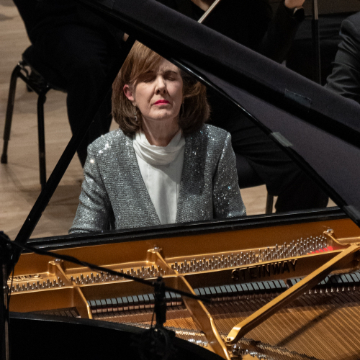
Pianist Anne-Marie McDermott performs Beethoven’s ‘Piano Concerto No. 5’ with conductor Carlos Miguel Prieto, and the North Carolina Symphony. (courtesy of NCS)
I could go on, but I’m not getting paid by the word. So I’ll conclude by saying that my first experience of a live performance of Beethoven’s “Emperor” was, if memory serves, with Horszowski and the New York Philharmonic in 1961 (a summer concert). I remember that performance vividly. Since that time, I’ve enjoyed many other fine performances, but the one in Raleigh this weekend actually redefined the concerto for me. McDermott’s performance was, far and away, the most emotionally agile version of Beethovenian heroism I’ve encountered. Desert island stuff.
Prieto was part of the reason. He clearly has a personal affinity with Beethoven. I don’t doubt he would conduct Beethoven even if Beethoven didn’t sell seats. When Stephen Hough performed Beethoven’s Concerto 3 with the North Carolina Symphony a couple of years ago, one heard the same conviction and deep belief in Beethoven’s embracing and inclusive insights. Hough was great. So was McDermott. Both shine with Prieto at the helm.
For her encore, McDermott played the “Prélude” from Bach’s English Suite No. 2 in A Minor. Talk about a finger buster! Angela Hewitt is, for good reason, many people’s go-to modern-piano Bach interpreter. McDermott couldn’t be more different. Again, put on that blindfold and hear how much McDermott achieves in being herself while letting Bach also be himself. Nothing like the estimable Hewitt, but your reviewer’s preference. A stunning encore that itself got two standing-ovation bows. ■
EXTERNAL LINKS:
- North Carolina Symphony: ncsymphony.org
- Carlos Miguel Prieto: carlosmiguelprieto.com
- Anne-Marie McDermott: annemariemcdermott.net

Read more by Christopher Hill.


.png)