

Michelle Cann, piano.
Florence PRICE: Piano Sonata in E minor
Florence PRICE: Fantasie nègre
Margaret BONDS: Spiritual Suite
Curtis Studio
Release Date: May 3, 2023
Format: Digital
Duration: 1:03:18
Giorgio Koukl | 8 MAY 2023
On her new album entitled Revival: Music of Price & Bonds, pianist Michelle Cann presents two extremely interesting woman composers of African-American origins — already enough to evoke a certain interest because discovering new music is always rewarding.

(cover art)
But there is far more.
First of all, Ms. Cann is a very, very capable pianist, who possesses a pristine technical command of the keyboard, and is capable of transmitting in every note a surprising calm and beauty, today a rare gift. Not a single note seems casual or just thrown there without pondering and without a well-constructed mental architecture. Her dynamic projection is very logical; in other words, she can tackle the two different worlds of Florence Price and Margaret Bonds without being in any difficult or unsolvable situation.
Secondly, the value of such a rarely played repertoire is incredibly high.
Coupling Ms. Price and her works with those of her younger colleague Bonds is a winning idea. These two ladies have very different approaches to music: the first tends towards a more classical, “European” style, but without being forcefully epigonal or copying any known composer.
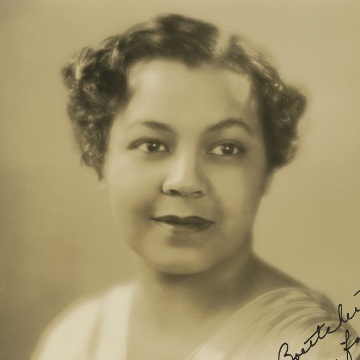
Margaret Bonds (historical image)
Meanwhile, Ms. Bonds, at least in her three shorter works called Spiritual Suite, divided into sections called “Valley of the Bones,” “The Bells,” and “Troubled Water,” which form the last part of this installment, is far more similar to what one can expect from a composer living in the particular world where George Gershwin and many other composers just started to collect and use the idiom of what we would today call the “American music,” a movement which luckily continues nowadays. Maybe there is the figure of Antonin Dvořák to remember, who nearly a half-century before tried to insert some typically American melodies, this time allegedly of Native Indian provenience, into his Ninth Symphony. The commingling of different cultures in all the known art forms was always beneficial. In this sense, the slow rediscovery of these gems is, per se, an outstanding achievement.
But let us return to the nine tracks contained in this recording.
We start with the rather known Piano Sonata in E-minor by Florence Price. It has the traditional three movements form where the single movements are called: “Andante-Allegro,” “Andante and Scherzo,” and “Allegro.”

Florence Price (historical image)
The first impression is of a never-ending state of grace where no dull passages disturb the quietly flowing source of great musical motives, well combined and perfectly well played by the pianist. Luckily many newly discovered pieces of hers are now available in print, so a real revival of this composer could be expected.
The second work of Florence Price is probably a first recording, even if no notice is given in the available online booklet. It is called Fantasie nègre, from which three parts are played: No. 1 in E-minor, No. 2 in G-minor, and finally No. 4 in B-minor.
All this music is simply delicious in its pristine musicality and subtle harmonic flow. Once again, one has to admire the ease of pianistic rendering which Ms. Cann can offer. The first piece may be the most complicated and daring in its harmonic texture, reflecting well the fact that it is also the longest track of the whole disc, at more than ten minutes.
Played in 1930 by the then 17-year-old Margaret Bonds, Fantasie nègre earned already then considerable public acclaim, a reaction which can be only shared today together with the question posed so many times before: Where has all this music been for so long while everybody was indulging in the mechanical repetition of the “standard” piano repertoire?
The two ladies, Price and Bonds, worked quite a lot together, giving each other a supportive hand in terms of reciprocal composition presentation, facts which are also well known. Both had to endure the curse of being female in a society dominated by males, both had to battle with the racial prejudices of their time, and both were given only a short lifespan in which to express their exceptional talent.
So it is only a logical conclusion to end this album with the spiritual suite.
As noted before, this music is far away from the world of her former teacher and friend, Price. Here we have a genuine use of jazz harmonics, certain spicy rhythmical elements, and far more free form if compared to the precedent music.
Nonetheless, Ms. Cann is at her ease with this music, giving us the privilege of a rare glimpse that is otherwise very difficult to obtain. Therefore this Curtis Studio product appearing just in time for the 70th anniversary of Ms. Price’s death, which also benefits from a superior technical treatment of the audio master, is an easy recommendation. ■
EXTERNAL LINKS:
- Michelle Cann: michellecann.com

Read more by Giorgio Koukl.





.png)