

October 15, 2023
Symphony Hall,
Boston, Massachusetts – USA
Andris Nelsons, conductor; Yo-Yo Ma, cello.
Franz Joseph HAYDN: Symphony No. 22 in E-flat, Hob. I:22
Dmitri SHOSTAKOVICH: Cello Concerto No. 2, Op. 126
Iman HABIBI: Zhiân
Dmitri SHOSTAKOVICH: Cello Concerto No. 1, Op. 107
Karl Henning | 17 OCT 2023
Even back in the 18th century, the nickname “The Philosopher” was attached to Haydn’s Symphony in E-flat, the 22nd in the catalog of “Papa’s” œuvre compiled over a period of more than forty years by nineteenth-century Dutch musicologist Anthony van Hoboken.
Haydn’s biographer Georg August Griesinger writes of the composer mentioning that in one of his oldest symphonies—one that he could not at that moment pinpoint (and since his symphonies number north of a hundred, who could fault him?) “the idea predominated of God speaking to an unrepentant sinner, asking him to reform, but the sinner in his rashness heeded not these exhortations.” Haydn scholar H.C. Robbins Landon believes this image best fits “The Philosopher.”
The scoring of this symphony is unique in the literature: the orchestra includes a pair each of horns and English horns—author and lecturer Steven Ledbetter offers an amusing aside that there were French critics who considered the inclusion of an English horn in César Franck’s Symphony in D minor of 1888 as a kind of “disqualification” for the genre of the symphony.
In the present performances in Symphony Hall, a harpsichord continuo was also included in the orchestra, played by Michael Beattie.
Haydn wrote so many symphonies, and orchestral programming was, in effect, restricted to the later symphonies for so very long, it is no great surprise that the first Boston Symphony performance of “The Philosopher” waited until 20 August 1976 at Tanglewood, led by Jorge Mester.
The first movement in Sunday’s performance moved at a clip that I could not help feeling was rather brisk for the marking, “Adagio.” While even at this pace, the movement exuded charm, there was room to give the music more breath without risking any charge of languor.
Curiously, this is my second experience of this wonderful piece in Symphony Hall, as I attended the performance under the direction of then Music Director James Levine in February of 2007. Overall, and notwithstanding my quibble, I find Maestro Nelsons’ account superior.
Uniquely in my experience at Symphony Hall, both the conductor and soloist took the microphone to offer ex tempore remarks. Maestro Ma spoke before performing the second Shostakovich Concerto (of the two, it appeared first in the program). He began simply by saying how pleased he was to see us, the audience.
In August of this year, he contracted COVID-19 and was forced to cancel his appearance at Tanglewood. He spoke warmly of how Shostakovich’s music “gave a voice to the voiceless,” the 20-plus million Russians who perished in the Stalin era. This is especially typified by the heartfelt 15-minute lament that is the Largo opening movement of the Cello Concerto No. 2. Ma also noted that the first performance of the Opus 126 by the BSO, under Seiji Ozawa’s direction, and with Slava Rostropovich as soloist, was 10 August 1975, the day after the composer’s death.
In February of 1966, Shostakovich wrote to his friend, theater historian Isaak Davidovich Glikman (1911-2003) saying that he had begun writing a fourteenth symphony and was retiring to Repino to work on it undisturbed. In fact, the symphonic work turned out to be the second Cello Concerto, conceived for “the fabulous Rostropovich,” and which the composer would later describe as “a kind of fourteenth symphony with solo cello part.”
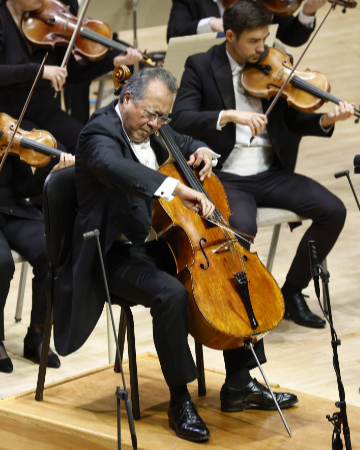
Yo-Yo Ma performing with the Boston Symphony Orchestra at Symphony Hall, Thursday, Oct. 12, 2023, in Boston. (credit: Winslow Townson)
The second movement begins with a Jewish pretzel vendor ditty from Odessa, “Kupitye Bubliki, and in a way that seems to echo the fate of the innocuously jaunty march tune in the first movement of the Leningrad Symphony, by the time our pretzel song appears at the end of the Concerto’s third movement, the tune has gradually mutated into a thing of virulent menace. The pensive humor returns and the Concerto concludes with a percolating percussion tattoo which both hearkens back to the middle movement of his magnificent Fourth Symphony (which Shostakovich withdrew from rehearsal in the face of the official disapproval of The Lady Macbeth of Mtsensk) and points forward to Shostakovich’s very last symphonic utterance, the close of his Fifteenth Symphony.
Ma and Nelsons collaborated exquisitely throughout both this and the Cello Concerto No. 1 that would later close the concert. I fully expect that the later release of these concerti on compact disc will earn high praise.
After the intermission, Maestro Nelsons took the microphone and announced that this performance was dedicated to the victims in Israel of the recent terrorist attack.
Zhiân was commissioned from Tehran-born Iman Habibi by the BSO and first performed at Tanglewood in July of this year. The composer himself writes:
The piece opened with various quarters of the orchestra in paired thirds kicking around a lyrical phrase whose contour suggests a kinship with the initial gesture of the Dies irae plainchant. The ebullient, ever-shifting piece exhibited a deft talent with the orchestra, and concluded on an undeniably positive cadence. ■
EXTERNAL LINKS:
- Boston Symphony Orchestra: bso.org
- Andris Nelsons: andrisnelsons.com
- Yo-Yo Ma yo-yoma.com

Read more by Karl Henning.


.png)