

October 15, 2025
Hodgson Hall, UGA Performing Arts Center
Athens, Georgia – USA
Camerata Nordica Octet (Shuichi Okada, Hanna Helgegren, Daina Mateikaite & Katarzyna Szydlowska, violins; Kimi Making & Sebastian Steinhilber, violas; Zephyrin Rey-Bellet & Filip Graden, cellos).
TRADITIONAL (arr. Camerata Nordica): “Lat till far” (“Song to my father”)
TRADITIONAL (arr. Camerata Nordica): Polska in A Minor (after Karl Lindblad)
Hanna HELGEGREN: Nordiska årstider (“The Nordic Seasons”)
Dmitri SHOSTAKOVICH: Two Pieces for String Octet, Op. 11
Felix MENDELSSOHN: Octet in E-flat Major, Op. 20
Mark Gresham | 21 OCT 2025
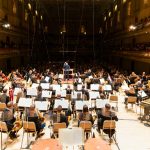
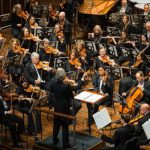
The Camerata Nordica Octet brought a bright, conversational energy to Hugh Hodgson Concert Hall in Athens, Georgia, last Wednesday night, turning a program that ranged from Nordic folk strains to Mendelssohnian fireworks into an evening that felt both carefully crafted and freshly immediate.
The Swedish ensemble—drawn from the principal players of Camerata Nordica and performing without a conductor—opened with two short arrangements of Scandinavian material: a plaintive “Låt till far” (“Song to my father”) and a sprightly Polska in A Minor (after Karl Lindblad). The arrangements, credited to the ensemble, framed the concert in the language of intimate storytelling—the first a hymn-like address to memory, the second a rustic dance whose asymmetrical accents the players dispatched with clean ensemble and an almost improvisatory buoyancy. Modest in scale, the pieces proved an ideal way to showcase the Octet’s unanimity of sound and its ear for small, telling details.
Violinist Hanna Helgegren, credited on the program as composer of a new work titled Nordiska årstider (“The Nordic Seasons”), stood at the center of the evening both as soloist and creative force. The four-movement piece, recently presented by Camerata Nordica in projects exploring Swedish folk material and receiving its live concert world premieres on this U.S. tour, uses familiar modal gestures and transparent textures to suggest weather and ritual rather than directly depict the literal scenes shown in the video projected on a screen behind the musicians.
Helgegren’s writing allowed the ensemble to float and shade phrases, and the players responded with a sensitivity that kept the music atmospheric rather than merely decorative. Its restrained climaxes were particularly effective in Hodgson Hall’s acoustics, where a single bowed note seemed to bloom before fading.
Midway through the program, the Octet shifted to Dmitri Shostakovich’s Two Pieces for String Octet, Op. 11—a pair of character sketches written in the 1920s when the composer was still finding his public voice. The “Prelude” unfolded with a melancholic clarity, the kind that makes Shostakovich’s early lyricism feel both inevitable and haunted. The “Scherzo” that followed was fleet and sarcastic, its brittle off-beats sharpened by the ensemble’s crisp articulation. The group negotiated the leap from Nordic atmospherics to Russian modernism without sacrificing tonal warmth, and the players’ precise unison work on the Scherzo’s staccato figurations earned the room’s instant approval.
The second half belonged to Mendelssohn’s Octet in E-flat Major, Op. 20, one of chamber music’s perennial pillars. Composed when Mendelssohn was just 16, the work is equal parts prodigious craftsmanship and unforced joy. Under Camerata Nordica’s hands, it became a study in collective character. The ensemble gave the music its full breadth while preserving chamber-level transparency: themes passed from instrument to instrument with rhetorical clarity, and the “Scherzo”—a ballet of quicksilver string effects—had the lightness and precision it demands. If there was any risk of overstatement in the work’s broad climaxes, the Octet mostly avoided it, preferring articulation and line over sheer volume.
The two cellos provided a sonorous yet agile foundation, their duet passages in the Mendelssohn finale both robust and fleet. The violas offered a warm inner core that the violins could play off, and the four-violin textures, when fully balanced, produced a rare ensemble shimmer that felt spontaneous. The Octet’s decision to play from memory heightened that sense of communal listening.
Hodgson Concert Hall proved a flattering room for the ensemble, allowing quiet passages to retain their detail and louder tuttis to project without harshness—a reminder that chamber repertory often benefits as much from architectural sympathy as from technical polish.
If the program had one modest shortcoming, it was that the evening favored clarity and stylistic fidelity over risk. Camerata Nordica’s reading prized craft and ensemble cohesion over visceral surprise and unguarded spontaneity. Still, the reward was consistent: a group of musicians listening to one another with the kind of attention that turns notes on a page into living music.
The concert’s repertoire arc offered a tidy cross-section of the string octet’s expressive possibilities. For listeners in Athens on October 15, the performance was a reminder that chamber music’s smallest formations can produce a fullness of effect when players share a coherent aesthetic and a responsive ear. ■
EXTERNAL LINKS:
- Camerata Nordica Octet: cameratanordica.com/octet
- University of Georgia Performing Arts Center: pac.uga.edu

Read more by Mark Gresham.


.png)