

October 17 and 18, 2025
Meymandi Concert Hall
Raleigh, North Carolina — USA
North Carolina Symphony; Carlos Miguel Prieto, conductor; Samuel Almaguer, clarinet.
Carlos CHAVEZ: Symphony No. 2 (Sinfonia India) (1936)
Aaron COPLAND: Concerto for Clarinet and String Orchestra (1948)
Aaron COPLAND: Symphony No. 3 (1946)
Christopher Hill | 21 OCT 2025
How many regular subscription symphony concerts have you been to where every work on the program was by a North American composer? In your reviewer’s case, the number is vanishingly small, if not zero. This weekend’s program in Raleigh is unusual, then. It’s also special because the music director of the North Carolina Symphony, Carlos Miguel Prieto, has performed these pieces for years, all over the world, and his affection for each of them runs deep.
First up, Symphony No. 2 by Carlos Chavez, subtitled Sinfonia India. As the dust of contention settles on the output from modernist composers during the second third of the twentieth century, it becomes increasingly clear that Chavez’s cycle of six symphonies is one of the treasures of twentieth-century orchestral music. His most-played symphony, Symphony No. 2, created in 1936, almost defiantly demonstrates the power of indigenous Native American music.
Key to that power is the inclusion of indigenous Native American musical instruments. Here, the role of Prieto in tonight’s performance was decisive, for he has collected all the ancient instruments (some documented in Mayan art) that Chavez calls for; thus, he performs the symphony with the exact sounds the composer hoped for, not with the roughly (at best) equivalent sounds of standard orchestral instruments. Before raising his baton, Prieto treated the audience to a demonstration of the differences in sound between each indigenous Mexican instrument and its European equivalent.
The differences are substantial, largely due to the fact that European instruments reflect technologies unknown to ancient Native Americans. Those technologies enable European instruments to “pack a punch” not heard in the authentic instruments. But that punch can skew the musical message. Using authentic instruments results in a lighter, less sententious texture that dances rather than stamps its foot, a texture that better communicates the joyous nobility intrinsic to the voices of Mexico’s indigenous peoples as they unselfconsciously celebrate their lives.
It’s also worth noting that in claiming this one-movement work to be a symphony, Chavez boldly asserts his right as a composer to favor musical juxtaposition over the use of variation, sequential techniques, and transitions, as found in gringo symphonies. All those techniques are actually present in Symphony No. 2, but they are, as it were, recessive traits—juxtaposition rules.
The trick for the conductor and orchestra in Symphony No. 2, then, is to find just the right tone and contrast for all those juxtapositions. If successive sections are too much alike, a sense of aesthetic complexity is lost; if too many successive sections are too different, then the work becomes episodic instead of continuous. Suffice it to say that Prieto has the full measure of this music, and the performance by the North Carolina Symphony was exemplary, raising the bar higher than any recorded performance your reviewer knows (I know four such). The work is not long, but it has the deeply felt gravitas and the emotional heights we look for in great classical music.
Next up, Aaron Copland’s 1948 Concerto for Clarinet and String Orchestra, with the strings augmented by a piano and harp, and with the solo here played by the Raleigh ensemble’s principal clarinetist, Samuel Almaguer. Copland returned from studies in France just in time to be back in New York when another city resident, George Gershwin, premiered his Rhapsody in Blue. Copland’s creative response was, in works like Music for the Theater and the Piano Concerto, to try bridging the gap between high art and urban pop art. By the late 1920s, however, Copland was ready to move on, and with works like Vitebsk, Symphonic Ode, Piano Variations, and Statements for Orchestra, he did so by establishing an Old Testament-ish prophetic voice that remained thereafter at the center of many major works, right up through his last major orchestral pieces, Connotations and Inscape.
Copland’s friendship with Carlos Chavez exposed him, in the 1930s, to parts of the North American world outside the five boroughs, particularly to the endless stretches of rural agriculture, small towns, and arid western lands that then as now surrounded roads between the Big Apple and Chilangolandia (Mexico City). The eventual result was the rural, populist style for which Copland is best known. The peak of this populist period was the composer’s 1946 Symphony No. 3, also on tonight’s program. But shortly after that work premiered, the renowned clarinetist Benny Goodman presented Copland with a blast from the past: an invitation to write a jazzy urban work for clarinet. Been there, done that—but the money for agreeing was substantial. Who wants to be a starving artist?
Copland hied himself to Rio de Janeiro (why not?), where he completed a slow movement for a clarinet concerto—a serene, lyrical meditation that is far more like a Satie Gymnopedie than it is like blues or hot jazz. But something was cooking in Rio de Janeiro, and that something was Choros, claimed by one writer to be the most sophisticated popular instrumental genre in the world. Copland became enamored of Choros, which by then had developed significant overlaps with jazz. When he returned home, he brought his enthusiasm for Choros (plus a number of Choros tunes) with him. The result was a Choros-inspired fast movement for a clarinet concerto, a movement far jazzier than anything Copland wrote in the 1920s.
Most concertos, as you know, have three movements, but Copland decided to stop at two (as he had in his 1926 Piano Concerto). He then connected these very different movements with a two-minute solo cadenza. The Concerto for Clarinet and String Orchestra was premiered by Goodman and the NBC Symphony Orchestra under Copland in November 1950; Columbia Records released a recording of the work with the same artists in September 1951. Obviously, one would not be remiss in considering a composer’s creation of his own work with the dedicatee playing when reviewing another performance, such as the one tonight. And your reviewer shall do that now.
In a phrase, and with all due respect, there’s no comparison. Almaguer played with a bracing verve, nimbleness, and subtlety. Few, if any, clarinetists in the world could play this challenging score better. His tone in all registers was gorgeous, with the appropriate exception of a few passages in the second movement where Copland has the clarinet wail fortissimo at the top of its range over a full (and loud) ensemble. His precise but relaxed rhythms created jazzy effects where Goodman could not. His pacing, too, brought some of the freshness and unpredictability of jazz to the performance.
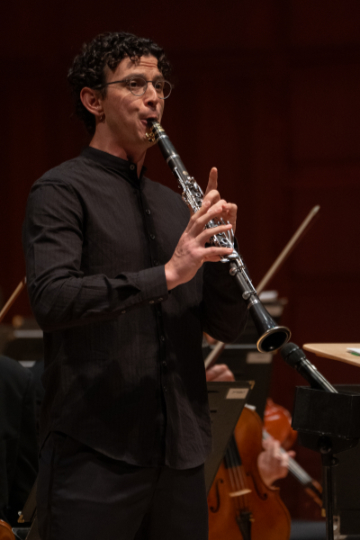
Samuel Almaguer solos in Copland’s “Clarinet Concerto” with the North Carolina Symphony, October 17, 2025.(courtesy of NC Symphony)
Elsewhere, I have repeatedly mentioned how cannily Prieto regulates instrumental balances. In this performance, your reviewer heard felicitous combinations where he had never heard them before, and from beginning to end this performance seduced the ears. The late Bernstein-led performance of this concerto is suave, indeed, but the sounds Prieto coaxed from the North Carolina Symphony were even better. The audience leapt to their feet at the conclusion. Almaguer’s encore was inspired, a jazzy duo for clarinet and double bass by the distinguished American composer Morton Gould entitled “Benny’s Gig.” Another enthusiastic and well-deserved standing ovation followed.
After intermission, the orchestra tackled the Big Work of the evening, Aaron Copland’s Symphony No. 3. Prieto, who has recorded this work with the Symphony of the Americas, said in a pre-concert talk that while there is no consensus on which work of fiction is the Great American Novel, there is overwhelming consensus that Copland’s Symphony No. 3 is the Great American Symphony. Why? Perhaps, Prieto continued, because so many others, like himself, hear in the symphony a clear and uplifting message: “In this tragic time, we need to move on and find hope.”
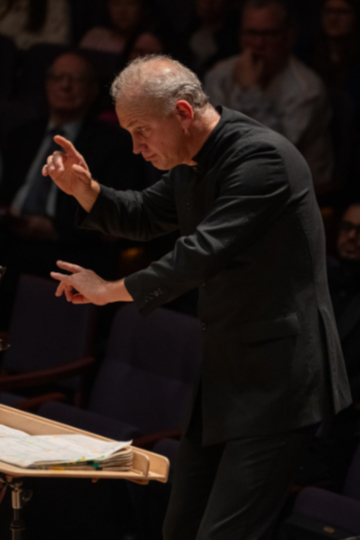
NCS music director Carlos Miguel Prieto leads Copland’s “Symphony No. 3,” Oct. 17, 2025. (courtesy of NC Symphony)
The orchestra used by Copland is a large one, and the many tuttis are almost always scored to produce great quantities of sonic energy. On the podium, Prieto sometimes seemed to be a man possessed, so intense was his own energy and concentration. The orchestra was clearly with him in spirit, but for whatever reason, rough edges in the playing were evident: a horn flub at a bad time, pizzicatos that spattered, sectional balances that disfavored the melody instrument, a piano solo that started a tad late, and so on. In many passages, one heard a finished performance, but overall, this evening in this piece, the band just wasn’t at its best. Perhaps the fact that, less than a week ago, it was playing a different program made it hard to find enough practice and rehearsal time. Or not.
In any event, the fourth movement of this symphony is, in your reviewer’s humble opinion, Copland’s most successful orchestral composition, and Prieto knows perfectly how to sculpt it: just when to hold back on dynamics or to relax tempos and just when to create build-ups or to throw caution to the winds. His baton often encouraged players to dig deep, to be gutsy, and they complied. The orchestra’s belief in the music, together with Prieto’s interpretive skills, brought the long movement effectively to its ecstatic, affirmative conclusion, and the effect on the audience showed the rightness of their approach. People left Meymandi Concert Hall happy and well satisfied, two and one-half hours after they first seated themselves for a concert of North American classical music. ■
EXTERNAL LINKS:
- North Carolina Symphony: ncsymphony.org
- Carlos Miguel Prieto: carlosmiguelprieto.com
- Samuel Almaguer: ncsymphony.org/people/samuel-almaguer

Read more by Christopher Hill.

.png)