
October 17, 19(m), 22, 25, 26(m), 2025
Winspear Opera House
Dallas, Texas – USA
Georges BIZET: Carmen
Emmanuel Villaume, conductor; Romain Gilbert, director; Georges Bizet, composer; by Henri Meilhac & Ludovic Halévy, librettists. Cast: Marina Viotti (Carmen), Saimir Pirgu (Don José), Teresa Perrotta (Micaëla), Gihoon Kim (Escamillo), Diana Newman (Frasquita), Kristen Choi (Mercédès), Matthew Goodheart (Remendado), Kyle Miller (Dancaïre), Laureano Quant (Zuniga), Eleomar Cuello (Moralès). Creative: Antoine Fontaine, set designer; Christian Lacroix, costume designer; Vincent Chaillet, choreographer; David Zimmerman, wig & make-up designer; Paolo Bressan, chorus director.
Gregory Sullivan Isaacs | 20 OCT 2025
The Dallas Opera transports us back to March 1875 and the premiere of George Bizet’s opera, Carmen, at the Opéra-Comique theater in Paris, France. At the time, it shocked the audience and most critics with its portrayal of the power of sex to drive otherwise moral men to dissolution and murder. After all, this was the Opéra-Comique! Sex was never mentioned, and God forbid, no one was ever murdered.
Let’s first talk about the singers first.
Bizet gave the title role to a mezzo-soprano. This type of voice, pitched somewhere between a soprano and a contralto, is excellent for mid-range dramatic portrayals. In the title role, Marina Viotti’s Carmen trends to the soprano side of the range, but she certainly delivers the goods when required.
The sturdy tenor, Saimir Pirgu, was excellent as Carmen’s prey, Don José, whose disintegration from country-boy-soldier to depraved, murdering outlaw was most fully realized in his final, desperate, and murderous confrontation with Carmen.
Teresa Perrotta supplied the soprano voice for the role of Micaëla, the ever-faithful, back-home girl. A more limpid sound would have served her well, especially in the Gounod-style arias. Dramatically, she is trapped by the character Bizet gave her, but she came into her own when she crashed the mountain hangout of the smugglers in search of José. (I always wanted to tell her that the way to a man’s heart is not delivering a kiss from his mother.)
As the much idolized toreador, Escamillo, the 1870’s version of today’s sports hero, Gihoon Kim had the swagger down pat, but his singing in the lower range bottomed out.
The critical secondary roles, so crucial for the action, were excellently cast.
As Carmen’s more flirty and vapid sidekicks, Diana Newman and Kristen Choi as Frasquita and Mercédès, liven up every scene in which they appear. As to the men, the marvellous voices of Laureano Quant as Zuniga and Eleomar Cuello as Moralès shine, as did Kyle Miller as Dancaïre, and Matthew Goodheart as Remendado. The chorus sang lustily, but they were clumped together too often (maybe because of the limited room downstage for them to spread out).
On Friday evening, conductor Emmanuel Villaume tended towards brisk tempi throughout. But, we must remember that this opera was written for the Opéra-Comique, and audiences were more used to lighter fare (and shorter works). The more serious moments were given the gravitas they deserved. The orchestra sounded wonderful and responded admirably to his wishes.
But all this aside…
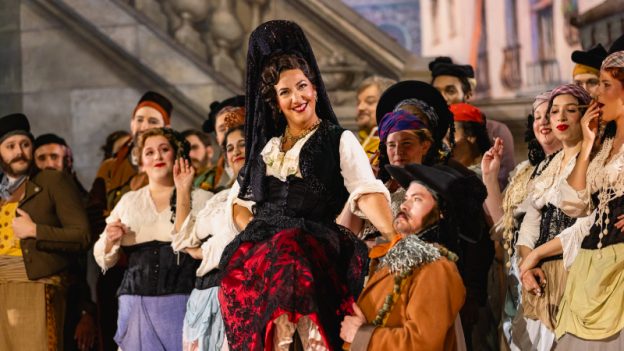
This 150th celebration of the opera’s premiere is beautiful to behold. Further, the costumes and hand-painted scenic drops closely resemble all historical records. Especially noteworthy is the perfection of the painting. These drops, which completely fill the stage on multiple levels going downstage, are huge, and realism is key to their success. You have to believe that they are actually real 3-D structures.

The Dallas Opera cast of ‘Carmen’ during Act 4. (credit: Kyle Flubacker)
In this, designer Antoine Fontaine, who created it in 2023 for a production in Rouen, France, succeeds with flair and élan. Even the curtains that frame the stage are trompe-l’œil (fool the eye) masterpieces. From the same production, the costumes, by Christian Lacroix, are also based on historical drawings and blurry early photographs. The lighting, by Hervé Gary, recreated for The Dallas Opera by Stéphane Le Bel, is much warmer than we usually see. While it features a row of footlights, nothing can quite capture the glow of gas lights.
Compared to present-day productions, the women are really quite primly overdressed. Décolletage is banished, and sexuality is more a subtle glance than actual physicality. But, this production is a rare treat to see Carmen as it was originally conceived, before a more modern concept of sexual excess took hold. ■
EXTERNAL LINKS:
- The Dallas Opera: dallasopera.org
- Emmanuel Villaume: emmanuelvillaume.com
- Romain Gilbert: romaingilbert.com
- Marina Viotti: marinaviotti.com
- Saimir Pirgu: saimirpirgu.com
- Teresa Perrotta: .teresaperrotta.com
- Gihoon Kim: intermusica.com/artist/Gihoon-Kim

Read more by Gregory Sullivan Isaacs.



.png)