
September 27, 2025
The Goat Farm
Atlanta, Georgia – USA
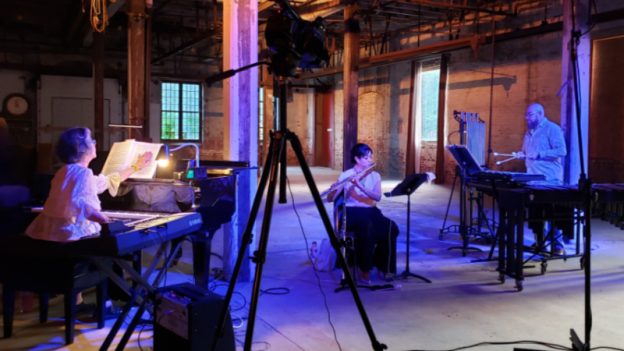
Chamber Cartel (Caleb Herron, percussion; Laura Gordy, piano; Teresa Feliciano, flute).
Morton FELDMAN: For Philip Guston
Howard Wershil | 2 OCT 2025
Concerts come. Concerts go. You pay your admission, show up on time, absorb the performance, draw your conclusions, share impressions with friends, agree that a good time was had by all, and return to the comfort and safety of home and hearth.
Yes, that’s the way it usually plays out. But every once in a while—every once in an all-too-seldom blue moon—you get something more. With SITE 2025 at The Goat Farm, you spend an elongated evening immersed in a staggering selection of exhibits and performances that challenge the mind and provoke the senses. What a unique opportunity!
As one of the featured performances on this comprehensive event, Chamber Cartel, a valued new music performance group already familiar to Atlanta audiences and contemporary music aficionados, presented a rare presentation of Morton Feldman’s For Philip Guston, a hauntingly gorgeous work spanning no less than 4 hours in length—or more.
In fact, much of Morton Feldman’s music is quite hauntingly gorgeous. Master of interjected silences and extended sonic decays, Feldman made an astounding career of creating primarily sensitive, quiet music that redefines the experience of instrumental sonority and color. For Philip Guston is no exception.
The composition is performed at a mostly quiet level, alternating questioning silences with delicate instrumental combinations—sometimes aligned, sometimes conversational, sometimes seemingly random.
Scored for flute (also piccolo and alto flute), piano (and celesta), and percussion (glockenspiel, vibraphone, marimba, and tubular bells), For Philip Guston, as with much of Feldman’s music, uses the natural qualities of the instruments to create a staggering variety of related color combinations. These are derived from a succession of differing but rather limited and somewhat repetitive pitch combinations—sometimes dissonant, sometimes consonant, sometimes both, and at times surprising in contrast.
The overall effect, for me, is to feel surrounded by a heavenly, benevolent cloud of sound that provides new and wondrous experiences slowly, softly, and charmingly—a pleasant universe of calm and grace placed gently and generously before me.
But to focus exclusively on the musicality of the piece would indeed be unfair to the composer and his sentiments. For quite a few years, Morton Feldman and Philip Guston (born Philip Goldstein) were good friends, sharing similar approaches to their art and a similar reverence for abstract expressionism.
A radical change in Guston’s approach to painting alarmed Feldman, and his alarm alienated Guston. Thus, their friendship ended. Even so, Feldman was still deeply affected by his former compatriot’s death, and his creation of For Philip Guston attests to that effect.
In truth, many a composer, both contemporary and historical, has generated works in response to the passing of someone close to them: Johannes Brahms’ A German Requiem, composed after the deaths of his mother, and his friend, composer Robert Schumann; Benjamin Britten’s War Requiem, dedicated to four of his friends who died in World War I; Mark-Anthony Turnage’s Remembering, a tribute to fellow composer Michael Morgan and German composer Siegfried Matthus, who both passed away in 2021; and Feldman’s own For Frank O’Hara, upon the untimely death of another very good friend of his.
Is it ironic, or simply quintessentially human, or both, that such personal tragedies can yield works of great power and beauty?
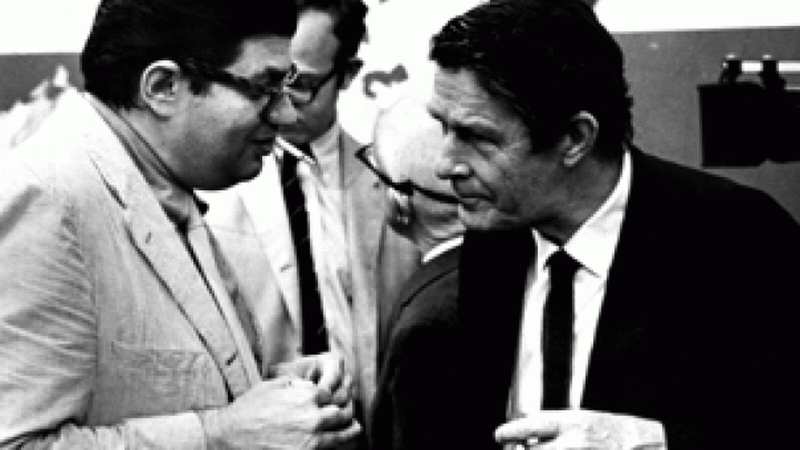
Morton Feldman and Philip Guston. (© Morton Feldman Photographs, Music Library, University at Buffalo, The state University of New York)
Before attending this performance, I had the pleasure of speaking with Chamber Cartel’s founder, percussionist Caleb Herron, about the ensemble’s vision, past, and future.
As it happens, For Philip Guston, completed on November 9, 1984, has been performed by Chamber Cartel twice before: once at their premiere concert in 2012 and again in 2016 at the New Music Gathering at the Peabody Conservatory. This third performance at The Goat Farm featured different performers from the previous two performances.
While many performers organize into ensembles for the purpose of musical coalescence, unity, and longevity, there are also many ensembles that exist for the purpose of exposing particular musical works using the best musicians at hand.
Chamber Cartel is an ensemble that delights in discovering a varying pool of musicians to employ for a variety of contemporary music events, and I’m certainly looking forward to what they will offer next.
The current performers of Chamber Cartel who valiantly accepted the challenge of bringing For Philip Guston to life for its audience—percussionist Caleb Herron, founder of Chamber Cartel and percussionist for the Johns Creek Symphony Orchestra; pianist Laura Gordy, well known for her work with Thamyris in bringing contemporary music works to the attention of Atlanta’s public and beyond; and flutist Teresa Feliciano, multifaceted freelance performer and flutist with The Clibber Jones Ensemble—performed with great sensitivity and elegant restraint, giving the piece every bit of magic it so richly deserved.
I knew, coming in, that I was not going to be able to attend the entire performance. Rest assured, though, had circumstances been different, I would have thoroughly enjoyed experiencing the work in its entirety.
Had circumstances been different.
Allow me to explain.
Experiencing SITE at The Goat Farm is quite an exciting yearly event. Set in a location featuring fresh, new apartments and studios, as well as more than a century-old buildings once dedicated to the cotton gin trade, it offers a promenade through over 40 visual art galleries and quite a few dance and music performance spaces as well.
Having been involved in similar but smaller endeavors at earlier times in my life, I have the utmost awe, respect, and understanding for the limitations in funding and manpower faced by any arts organization in mounting an event of such magnitude. That said, I would like to offer two observations that I hope event organizers will seriously consider for the future.
Let me first point out a minor issue.
While a somewhat comprehensive map was provided to help attendees locate all the events, it did not take into account that the older buildings had multiple floors housing these events. A bit more detail on the map would have been useful. As a result, I found it rather difficult to find the space housing Chamber Cartel’s performance without engaging in more wandering than necessary. Perhaps additional signage for the event, pointing attendees in the right direction for multiple events, would have been helpful. I would also recommend providing directions to accessible paths for people who need to avoid using stairs.
But then, there are issues of communication, comprehension, and compassion that event organizers must endeavor to fully achieve for every artist involved—objectives that, if not achieved adequately, can lead to chaos and disappointment—major issues, to be sure.
Once I found the space for Chamber Cartel’s performance—a rather magnificent space, with appropriately dramatic acoustics—I was met with the delicate, uplifting sound of Morton Feldman’s great work being overpowered by the loud, pulsing, booming hip-hop sounds emanating from the main performance stage, easily more than 100 feet away, if not 500 or more.
As someone familiar with Feldman’s genre of music, I might well be able to drown out the extraneous corrosive sounds in honor of my appreciation for the work at hand—but no one should have been required to do so! And for anyone hearing this sonic gem for the first time, and perhaps for anyone hearing the genre itself for the first time, the opportunity for genuine connection was completely thwarted. Indeed, I would categorize the situation as tragic.
I certainly cannot fault Caleb Herron or Chamber Cartel for creating a situation which must have been as surprising to them as it was to knowledgeable audience members. So I must question the organizational skills, musical acumen, and communication efforts of the SITE staff in generating this uncanny faux pas. My heart goes out to these dedicated Chamber Cartel performers who, I’m certain, forged on through the chaos with soaring commitment, even while their hearts may have been sinking.
I was not able to stay at SITE for the entire duration (I left around 7:30 PM; the event was scheduled to continue until 11 PM). I can only hope that, at some point, the stage music ceased, giving the musicians some relief and audience members a full opportunity to enjoy the glory of such outstanding music and extraordinary performance skill.
Chamber Cartel has some marvelous events planned for the future. On November 8, 2025, they return to Goodson Yard at The Goat Farm for a reprised performance of Iannis Xenakis’ Pléïades. We also look forward to their 2026 season, featuring commissions from composers Christopher Adler, Jordan Benator, and Nickitas Demos — and much more that we have yet to be told.
And we can always hope for yet another reprise of Morton Feldman’s expressive, devotional For Philip Guston, at a time and location where all audience members can appreciate its reverent depth and its excellent performance by one of Atlanta’s finest new music ensembles, Chamber Cartel.
I’ll certainly be watching for all their future endeavors. I fervently hope you will be, too. ■
EXTERNAL LINKS:
- Chamber Cartel: chambercartel.org

Read more by Howard Wershil.
RECENT POSTS
 Apollo Chamber Players finds ‘Tranquility’ in boldly conceived melding of two world premiere commissions • 06 Oct 2026


.png)