
February 20, 2026
Bailey Performance Center, Morgan Concert Hall
Kennesaw, Georgia – USA
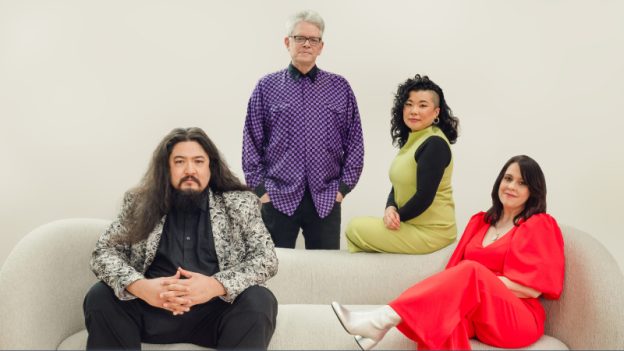
Kronos Quartet (David Harrington, violin; Gabriela Díaz, violin; Ayane Kozasa, viola; Paul Wiancko, cello).
Nicole LIZÉE: Another Living Soul
Raven CHACON: The Journey of the Horizontal People
Terry RILEY: Good Medicine
Philip GLASS: Dracula
Aleksandra VREBALOV: My Desert, My Rose
Jon Ciliberto | 3 MAR 2026
Nostalgia for the artists of one’s younger days can appear at odds with itself when a key aspect of an artist’s work is boundary-pushing. Soft memory seems to collide with hard challenge.
Kronos Quartet was formed in 1973 with the specific prospectus of “revolutionizing the string quartet into a living art form that responds to the people and issues of our time.”
Like many of those in attendance for Kronos Quartet at Kennesaw State University on February 20th, I am an old fan of the ensemble. Back in the early 1980s, the group was engaged in heroic work, not just by putting a spotlight on new music, but also by their willingness to present works related to social and political issues. I felt both of these purposes’ value. The founder, violinist David Harrington, once quipped that he wanted to be in the string quartet that had the largest FBI file.” Yes, as a high schooler, this revolutionary call was terribly compelling, and, to a degree, it probably colors my appreciation to this day.
The evening’s program was a mix of “old time” new music (by Terry Riley, Steve Reich, “Fifty,” Philip Glass) and more contemporary works. Three of the latter proceeded from the Quartet’s “Fifty for the Future” project. Launched in the 2015/16 season, this is “an education and legacy project that has commissioned—and distributed for free—the first library of contemporary repertoire for string quartet.” The commissioned “scores and parts, as well as supplemental learning materials that include recordings, videos, performance notes, and composer interviews” are all available on the Kronos Quartet website. kronosquartet.org. As each was presented, listeners were encouraged to download the scores and play the pieces themselves.
Browsing the site is a rich experience, particularly in advance of (or after) a performance.
The contemporary works on the program put more demands on the listener, if only from the fact that minimalism, the frequent form of Riley et al., has been around for half a century, after all. Another Living Soul (Nicole Lizée) incorporates what appeared to be long, colorful balloons that, when spun in the air by the performer, produced tones. (I imagined they were some plastic colored tube, but they looked like the colorful balloons used to make balloon animals. The webpage for this work indicates that they are “singing tubes, available in most toy stores.”) The players produce different pitches, based on speed of spin. The performers also stomped their feet (fairly common amongst the evening’s works, as it happens), played another toy, and also tiny bells with their (not stamping) feet, and also sang in places—vocalized pitches. As with other works that incorporated additional musical elements, it is difficult to assess the line between artistic value and simply being unusual, particularly when the toys have limited range in terms of pitch, dynamics, and expression.
Another “Fifty” composition, The Journey of the Horizontal People (Raven Chacon) “is a future creation story telling of a group of people traveling from west to east, across the written page, contrary to the movement of the sun, but involuntarily and unconsciously allegiant to the trappings of time.” I found the musical choices successful for their simplicity. That is, while there are many unusual techniques (including accented rests, double pizzicato, playing behind the bow—see the video on the Kronos page for an informative run-through), none are left merely at the doorstep; all are part of musical choices. The range of glissandi techniques, and how well the Kronos Quartet performed that, really stood out for me. The cumulative effect of the many non-standard techniques, all played with sensitivity and thoughtfulness, produced a performance that was spacious without feeling empty.
During Terry Riley’s Good Medicine, my wife whispered a word already in my mind: Americana. Surprisingly (to me), the work is part of “a ballet about Salome using her alluring powers to actually create peace in the world.” The work slots perfectly with the Quartets to combine music and meaning.
Philip Glass’s music for the movie Dracula and Alexandra Vrebalov’s My Desert, My Rose occupied space nearer to romantic music (the former certainly more friendly to the audience), but both gave the Quartet great space for group playing, pushing to heavy emotions and drama. Ms. Vrebalov’s work “consists of a series of patterns open in length, meter, tempo, and dynamics, different for each performer [with the] unfolding of the piece […] almost entirely left to each performer’s sensibility and responsiveness to the parts of other members of the group.” Performed, the ensemble brought to mind an elite group of athletes.
The unorthodox technique, less successful to me, was the use of pre-recorded material in several works (by Sun Ra, Peni Candra Rini, Steve Reich, perhaps others). Reich’s piece is for a triple quartet; thus, two Quartets’ worth of Kronos appear prerecorded. Two-thirds of the players are unable to react, so one-third has to lead to a more rigid performance. The Kronos’ ability to deliver (even against these odds) produced an energetic and immediate performance.
Rini’s work included “environmental sounds recorded in Borneo.” I imagined this was a nod to Indonesian music and to music played outside—with meaningful atmospheric sound all around (I am thinking of gamelan, but most recordings from that country and region include this element, precisely because the music was generally played out-of-doors). I felt it a bit heavy-handed in suggestion.
Another aspect that was an obstacle for me was the amplification of the Quartet generally. I understand that some types of very quiet playing can be difficult to discern in a large hall, but the general use of it to me it both de-centered the music from the musicians (which was disorienting), and also added more bass to the sonic range. Where I perceived effects used (delay, for example), I again wondered about the value added.
Other works on the program were born from a range of traditions and delivered across many voices. “New Music” covers a lot of ground. Kronos plays across all of it with excitement, expressiveness, and rigor. ■
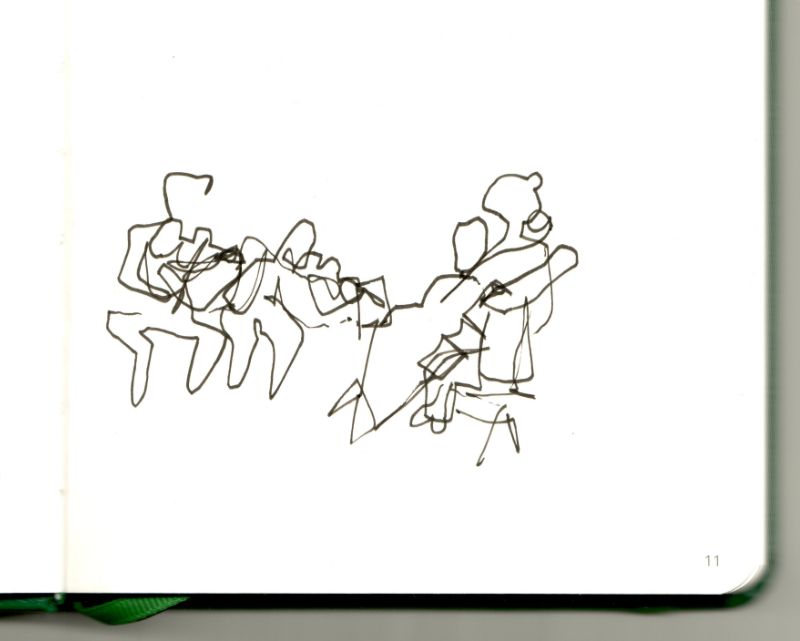
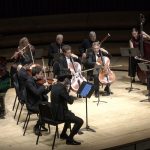
Sketch of Kronos Quartet performing at KSU, by Jon Ciliberto. (February 20, 2026, Bailey Performance Center, Morgan Concert Hall.)
EXTERNAL LINKS:
- Kronos Quartet: kronosquartet.org
- KSU Geer College of the Arts: kennesaw.edu/arts

Read more by Jon Ciliberto.
.png)