

February 28, 2026
Jones Hall
Houston, Texas – USA
Houston Symphony, Juraj Valčuha, conductor. Cast: Jamie Barton, mezzo-soprano (Brangäne)*; Tamara Wilson, soprano (Isolde)*; Nicholas Brownlee, bass-baritone (Kurwenal, Melot); Stuart Skelton, tenor (Tristan)*; Derek Welton, bass-baritone (King Marke). Creative: Matthew Webb, lighting designer; Erin Earle Fleming, co-lighting designer. (*Houston Symphony debut)
Richard WAGNER: Act II from Tristan and Isolde (1859)
Lawrence Wheeler | 2 MAR 2026
Houston Symphony Director Juraj Valčuha returned to Jones Hall for the third and final program of the Houston Symphony’s Doomed Lovers Festival, leading an all-star cast in Act II of Richard Wagner’s Tristan and Isolde. Jones Hall is no stranger to opera. Before the Wortham Theater Center opened in 1987, it served as the shared home of the Houston Symphony Orchestra, the Houston Grand Opera, the Houston Ballet Foundation, and the Society for the Performing Arts.
Making their Houston Symphony debuts were soprano Tamara Wilson and mezzo-soprano Jamie Barton. Both are alumni of Houston Grand Opera’s Young Artist Vocal Academy; both have appeared frequently with HGO; and both are Grammy Award winners. Wilson received a Grammy in 2022 for her participation in Mahler’s Symphony No. 8 under Gustavo Dudamel, and Barton for her starring role in HGO’s Grammy Award-winning production of Intelligence by Jake Heggie. Tenor Stuart Skelton also made his Houston Symphony debut. Renowned for his Wagner interpretations—especially Tristan and Isolde—he is in high demand as a heldentenor (“heroic tenor”). Versatile bass-baritone Derek Welton has performed internationally in repertoire ranging from Bach to Bartók. Bass-baritone Nicholas Brownlee, recipient of the 2025 Richard Tucker Award and named 2025 International Opera Awards Male Singer of the Year, is a graduate of Rice University’s Shepherd School of Music and an alumnus of Houston Grand Opera’s Young Artist Vocal Academy.
Regarded as Wagner’s most symphonically rich opera, Tristan and Isolde assigns equal importance to the orchestra. Through leitmotivs—“leading motives”—the orchestra articulates the emotional and psychological landscape as vividly as the singers. A meditation on love and death, the opera famously opens with the “Tristan chord,” one of the most consequential sonorities in Western music. Leonard Bernstein described it as the most revolutionary moment in modern music, claiming that Western music was never the same afterward. Its ambiguous, unresolved harmonies—built on augmented intervals—create a sustained atmosphere of yearning that mirrors the lovers’ longing. In Act II, the celebrated Love Duet approaches consummation, only to be interrupted, musically and dramatically. Resolution comes only in Isolde’s Act III Liebestod (“Love-Death”) over Tristan’s body; unity is achieved only through death.
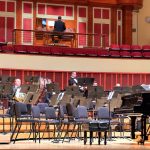
Valčuha, who considers opera central to an orchestra’s artistic growth, has previously led semi-staged performances of Richard Strauss’s Salome and Béla Bartók’s Bluebeard’s Castle with the Houston Symphony. This version of Tristan was similarly semi-staged, with English surtitles. The singers appeared in formal concert attire and dispensed with props, including swords. Atmospheric lighting, projected onto the back wall and ceiling, substituted for scenery. The orchestra, seated onstage with stand lights in a darkened hall, produced a clarity of texture not always heard from the pit. That transparency initially posed balance challenges for Barton and Wilson in their lower registers, but adjustments were quickly made. Thereafter, both projected with commanding presence. Even offstage, Barton’s voice carried effortlessly with a luminous shimmer. Wilson matched her in volume and authority, offering a slightly darker timbre and a performance both thoughtful and impassioned.
The emotional centerpiece was the extended love duet in Scene 2. Skelton’s imposing stature and thunderous heldentenor embodied the proud yet vulnerable Tristan. He seemed to inhabit the role completely, his devotion to Isolde convincingly rendered. Wilson answered with a nuanced range of dynamics and expressive shading that was both touching and compelling. Their combined intensity was electrifying. Valčuha shaped the orchestra as an equal partner in this musical ménage à trois, weaving seamlessly through the vocal lines with sensitivity and ardor.
In Scene 3, Brownlee—appearing briefly as Kurwenal and then as Melot—sang with authority and firm tonal focus, leaving one wishing for a larger role. Welton’s King Marke was deeply affecting, conveying shock and betrayal with a darkened tone that occasionally fractured under emotional strain. Tristan attempts to justify himself but ultimately cannot; his motivations belong to another realm, beyond the king’s comprehension. The scripted sword fight between Tristan and Melot was suggested instead through a sudden wash of red light as the two faced one another—an economical yet effective dramatic solution.
Throughout, Valčuha demonstrated acute sensitivity to orchestral color and dramatic pacing. The playing was exemplary. Particularly notable were the eloquent bass clarinet solos by Alexander Potiomkin and the nobly shaped French horn solos by William VerMeulen.
Presenting only Act II necessarily omits the opera’s iconic Prelude and Liebestod—the beginning and the end of Wagner’s vast arc. Nor can a semi-staged performance fully replicate the spectacle of a complete production. Yet what was offered possessed undeniable artistic weight: extraordinary singers and a superb orchestra in one of the repertory’s towering masterpieces. Under Valčuha’s masterful guidance, the result was nothing short of sensational.
The program was repeated Sunday afternoon. ■
EXTERNAL LINKS:
- Houston Symphony: houstonsymphony.org
- Juraj Valčuha: jurajvalcuha.com
- Jamie Barton: jamiebartonmezzo.com
- Tamara Wilson: tamarawilsonsoprano.com
- Nicholas Brownlee: brownleebassbaritone.com
- Stuart Skelton: stuartskelton.com
- Derek Welton: derekwelton.com

Read more by Lawrence Wheeler.


.png)