
March 13–15, 2026
Cullen Theater, Wortham Theater Center
Houston, Texas – USA
Carlisle FLOYD: Of Mice and Men
Benjamin Manis, conductor; Kristine McIntyre, director; Carlisle Floyd, composer; John Steinbeck, source material. Cast: Demetrious Sampson, Jr. (Lennie Small), Sam Dhobhany (George Milton), Alissa Goretsky (Curley’s Wife), Shawn Roth (Curley), Ziniu Zhao (Candy), Geonho Lee (Slim), Michael McDermott (Carlson), Luka Tsevelidze (Ballad Singer). Creative: Luke Cantarella, scenic & projections designer; Kara Harmon, costume designer; Kate Ashton, lighting designer.
Sherry Cheng | 16 MAR 2026
The music world is celebrating American opera legend Carlisle Floyd’s centenary this year. Widely known as the “Father of American opera,” Floyd composed 12 operas in all, crafting his own libretto for each work. He created a distinctly American operatic language steeped in the vernacular and rooted in our shared humanity.
This weekend, Houston Grand Opera honored its unparalleled relationship with Floyd with two performances of his masterpiece Of Mice and Men (1970). It’s a full circle moment for the company. Floyd’s influence on HGO extended far beyond the five world premieres and numerous other productions of his works here over the last half-century. Most significantly and farsightedly, Floyd and then General Director David Gockley co-founded the HGO Studio in 1977. Renamed the Butler Studio, it is now one of the country’s foremost pre-professional training programs for emerging artists. The entire cast of this production comes from the current class of Butler Studio artists, a fitting tribute to Floyd’s vision for the company.
Based on Steinbeck’s own stage play of his classic 1937 novella, Floyd’s finely crafted libretto tells the tragic story of two migrant farm laborers, George and Lennie, searching for a place of their own to call home. Lennie is mentally disabled and retains a child-like innocence despite his brute strength, while George is committed to protecting Lennie from harm. Together, they dream of owning their own farm one day. While the story of George and Lennie is central, it is not the only story in the opera. The power dynamic between Curley and his wife makes for riveting drama, as well as her destructive power on the men around her. The old ranch hand Candy, the foreman Slim, the harmonica-playing Ballad Singer–each is a clearly delineated character with his own pathos, appealing to the audience’s empathy.
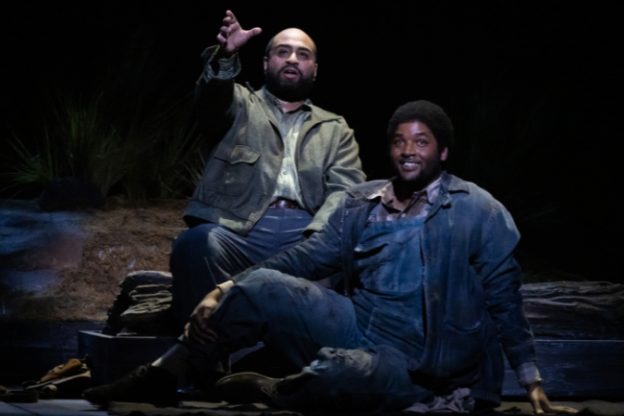
Director Kristine McIntyre’s new production, inspired by the pioneering work of Depression era documentary photographer Dorothea Lange, lets the audience truly see each character as a real human being–all the suffering, struggle, loneliness, and hope, with as much clarity and authenticity as the enduring gaze in some of Lange’s most iconic portraits of migrant laborers and farm workers. The stark framework of Scenery and Projection designer Luke Cantarella’s bunkhouse and barn in the foreground is set against an expansive and cinematic landscape, conjured by projections on sliding panels. Thoughtful lighting design by Kate Ashton helped highlight the unfolding psychological drama, as when the bunkhouse was suffused in pink and lilac tones that echo the patterns on Curly’s Wife’s dress as she dominates the room with her unbridled sensuality. Costume designer Kara Harmon’s attention to detail–hats, overalls, jackets, patterns, and layers gave individuality to each of the characters.
The entire cast was outstanding, and the palpable chemistry amongst them deepened the emotional dimension of the characters and heightened the dramatic tension of the story. As Lennie and George, tenor Demetrious Sampson, Jr. and bass baritone Sam Dhobhany carried the dramatic heft of the biggest roles of their careers with absolute conviction from first scene to last. After the opening chase scene, where the pair is fleeing from the police after Lennie touches a woman’s skirt, the pair hides in a river gully. George breaks into his first aria, “My life would be so simple by myself.” Dhobhany immediately captures our attention with his resonant, full-bodied voice. There’s an edge in the voice that signals his frustration with Lennie, yet a warmth that returns when he promises to stick with Lennie despite the constant trouble he causes. Sampson’s tender response in “It was something I could stroke,” describing the soft, furry mouse he accidentally killed, is a portentous first glimpse into Lennie’s struggle between gentleness and violence. The first scene builds into a hopeful climax as George and Lennie sing “One day soon,” dreaming of the farm they hope to own and call home one day. The tune is reminiscent of a lilting American folk song, which Dhobhany and Sampson deliver with a whole lot of heart. It returns throughout the opera and comes to its inevitably tragic denouement in the final scene.
As the landscape rolls by from mountains to plains, over bridges and roads, the scene shifts from river gully to bunkhouse. Ranch owner Curley, played by Shawn Roth, launches into a series of angry invectives, cursing the tardiness of his new hires with unrelenting force. He has major anger issues, and Roth turns up the heat on Curley’s boiling rage with great control. Soprano Alissa Goretsky, utterly alluring as Curley’s wife, makes a grand entrance in a pretty dress. The only woman in the story, she is the embodiment of sensuality and vanity. She flirts. She demands attention. She commands the room. She is trouble, but in a different sense than Lennie is trouble, because she is fully aware of her destructive power over men. Goretsky’s ravishing coloratura shines brightly in this role, each soaring and virtuosically delivered phrase a triumph of her power. Alas, that power is illusory, a facade for the loneliness that leads her to dreams of escape, and ultimately to her own tragic end.
Floyd is brilliant at building a scene to an emotional climax. One of the most powerful is the trio at the end of Act II, when the old ranch hand Candy, beaten down by being forced to have his old dog shot to death, becomes hopeful again when he finds out Lennie and George want to buy their own farm. Candy, portrayed with gravitas by bass Ziniu Zhao, joins them as they picture the idyllic life awaiting them on their farm, their exuberant voices carrying their dreams on high.
As the foreman Slim, baritone Geonho Lee is the steady voice of reason throughout the opera. He has come to terms with the reality of the ranch worker’s hard and lonely life. With wisdom, not bitterness, Lee delivers a deeply moving, thoughtfully measured aria. He sings of George’s dream, “none of us has ever made it come true. I don’t know why. It just never does. Born to live alone…ranch hands die alone, strangers to the world.” He is nevertheless kind to George and Lennie, adding that it may be different for them. Tenor Luka Tsevelidze played the role of the Ballad Singer, very much in the groove as he crooned the melancholic tune “Movin’ on.”
The final scene of the opera circles back to “One day soon” as George, in a final act of kindness, must shoot Lennie to save him from being lynched by Curley’s mob. Here, the two companions dream about their farm again. In Act I, Lennie “almost” sees it. Now, he finally says, “I see it. I see it. Over there. It’s our home.” George pulls the trigger. Our hearts are shattered.
The young artists of the Butler Studio have more than proven that they are indeed the future of opera. It has been almost two decades since the last all-Butler Studio production at HGO. From the enthusiastic standing ovation, it is clear that this is a tradition that must be revived and continued. Even though the production was presented in the smaller, more intimate Cullen Theater with a tiny pit that required a much-reduced orchestra, the impact was tremendous. ■
EXTERNAL LINKS:
- Houston Grand Opera: houstongrandopera.org
- Vutler Studio: houstongrandopera.org/butler-studio

Read more by Sherry Cheng.
.png)